
Tynker
Ages 5-17 · freemium · Curriculum · tynker.com ↗
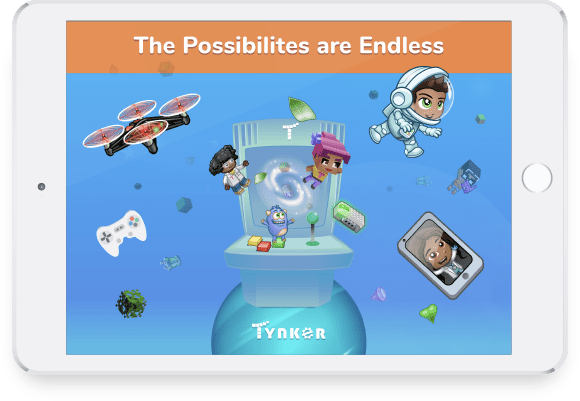
Tynker is a self-paced coding platform where kids start with drag-and-drop block puzzles, then graduate to writing JavaScript and Python. Beyond guided lessons, kids build their own games, animations, music, art, and Minecraft mods in a sandbox environment, and can publish finished projects to a moderated community where other kids browse and remix them. It covers ages 5-18 across 70+ courses, with a separate Tynker Junior app for pre-readers.
Tynker has focused developmental strength worth knowing about. It builds creativity. The main growth opportunity: The product is heavily scaffolded.
Strengths & gaps
Strengths
- ● Tynker’s strongest developmental signal is creativity. Kids can build original games, apps, stories, music, art, and Minecraft mods, then remix and share work with others.
- ● The platform has a real block-to-text bridge. Official pages show progression from block coding into JavaScript, Python, and other text languages.
- ● The scope is broad without becoming abstract. Game design, Minecraft, robotics, drones, art, music, and web development all give kids concrete reasons to code.
Gaps
- ○ The product is heavily scaffolded. It is designed to make coding feel approachable, which keeps frustration low and limits persistence practice.
- ○ Social learning stays shallow. Kids can publish, browse, and remix, but the core experience does not require sustained peer interaction.
- ○ Purpose is implied rather than explored. Tynker helps kids make things, but it does not push them to reflect on identity, values, or contribution.
Detailed scores
How Tynker performs on each of the 9 literacies in our framework.
Doing
— 0 of 3 Strong
Tynker gives kids real choice inside a structured product. The self-paced plan, sandbox projects, and topic-based courses let them decide what to explore. But the path is still designed for them, with tutorials, levels, and guided sequencing.
Kids do have to keep trying when a project does not work, and Common Sense notes that they get retries and hints. Still, the product is tuned to reduce friction quickly, so it does not create the kind of sustained struggle that would justify Strong.
Tynker asks kids to move from blocks into text languages and to switch across different kinds of coding tasks. That does require flexible thinking. The limitation is that all of it happens inside a curated curriculum rather than in an open-ended problem space.
Thinking
— 1 of 3 Strong
The range of topics is a clear curiosity engine. A child can drift from games to Minecraft to drones to music to web design. Even so, the lessons are still mostly answer-led, so curiosity is sparked more than cultivated.
Tynker is built for making. The sandbox, project templates, remix features, and wide range of creative outputs make this more than a lesson app. Kids can produce something original and share it, which is enough open-ended creation to earn Strong.
Coding requires evaluating logic, testing hypotheses, and choosing efficient commands. That is real judgment work. But the product does not broaden into ambiguous or value-laden decisions, so the judgment it builds stays technical.
Being
— 0 of 3 Strong
The monitored community supports publishing and remixing, and Common Sense Education notes project collaboration in classroom use. That creates some connection, but not enough to feel like a true social platform. There is no meaningful messaging or ongoing peer negotiation.
Tynker uses rewards, hints, and frequent progress signals to keep kids moving. That is good for engagement, but it means the product rarely leaves a child sitting with frustration long enough to practice managing it.
Tynker helps kids see coding as a tool for making tangible things. The platform also emphasizes future skills and confidence. What it does not do is connect that work to values, service, or identity in a sustained way.
Based on 8 sources
- Review commonsensemedia.org — tynker coding games for kids
- Review commonsensemedia.org — tynker
- Review commonsense.org — tynker
- Product tynker.com
- Product tynker.com — about
- Product tynker.com — pricing
- Product tynker.com — tynker
- Product tynker.com — learn create and collaborate in tynkers safe sharing community
Reviewed by New Literacies
Scored by our research-derived framework · AI-assisted analysis with editorial review · 8 sources reviewed · Our methodology →
Get the next guide before it goes live
One email when a new product review ships.
Free. No spam. Unsubscribe anytime.
See other products strong in the same literacies: