Tiny Polka Dot
Ages 3-8 · paid · Product · mathforlove.com ↗


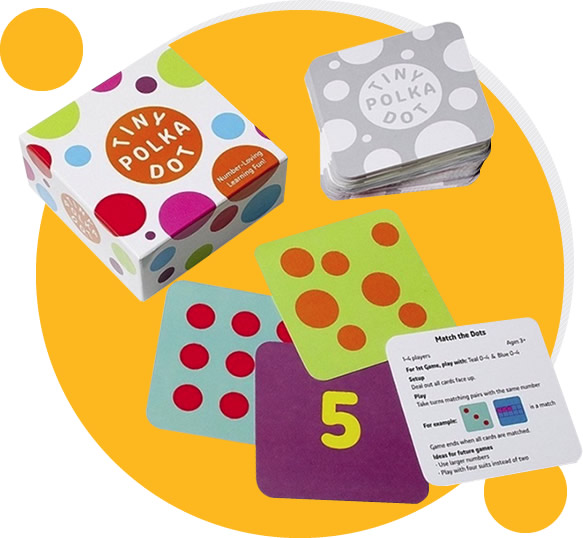
Tiny Polka Dot is a colorful early-math card deck with 16 different games built into one box. Children match, count, compare, add, remember, and notice patterns with the same cards, then move into harder variants as they grow. This score is for the core deck and included rules. It does not cover broader Math for Love curriculum materials.
Tiny Polka Dot has focused developmental strength worth knowing about. It builds persistence, curiosity. The main growth opportunity: Agency is real but partial.
Full review
The NL Score measures developmental capacity-building, not product quality.
Strengths & gaps
Strengths
- ● Tiny Polka Dot is strongest for Curiosity and Persistence. The same deck keeps opening new play patterns, and children can grow into harder games instead of aging out after one skill.
- ● The product treats early math as something to explore, not something to endure. That matters for young children who are just forming an identity around numbers.
- ● The grownup guidance is thoughtful. Adults are told to slow down, think out loud, and follow the child's lead rather than turning the game into a test.
Gaps
- ○ Agency is real but partial. Children make choices inside the deck, but an adult usually frames the activity and selects the starting point.
- ○ Creativity and Connection are present only in moderate ways. Tiny Polka Dot is flexible, but it is still a designed game system rather than a truly open-ended social or making tool.
- ○ Judgment and Purpose are not the point here. The age range is too young, and the deck is focused on early number sense.
Detailed scores
How Tiny Polka Dot performs on each of the 9 literacies in our framework.
Doing
— 1 of 3 Strong
Tiny Polka Dot gives children room to act. They choose cards, make moves, and often move into a harder game when they are ready. But adults usually set up the session and choose the ruleset. That keeps Agency meaningful without making it central.
Tiny Polka Dot builds persistence by letting challenge scale with the child. A game that feels easy this month can give way to a tougher one next month without changing products. The teacher reaction in the corpus is the clearest signal: the child who shouted "I can do tough things" is exactly the kind of recovery-and-try-again evidence this rubric looks for.
The deck keeps changing what numbers look like. Dots, numerals, matching, memory, and sum-building all ask the child to shift attention and strategy. That is useful adaptability practice. But it stays inside a tightly related set of early-math tasks, so Moderate fits.
Thinking
— 1 of 3 Strong
Curiosity is one of Tiny Polka Dot's best qualities. Sixteen game modes give children a reason to keep poking at the same materials in new ways. That is why the deck feels more alive than a static flashcard set. There is always another pattern, another rule twist, or another harder game to try.
Tiny Polka Dot has some creative energy because children can experiment with strategies and move through the deck in different ways. The games are playful enough to invite invention inside the system. But the system is still authored for them. There is no blank canvas or artifact creation, so Moderate is the right ceiling.
The scoped audience starts at age 3, and most of the evidence is about very young learners. That makes a package-wide judgment score too unstable. Not Assessed is a better fit than pretending the deck is designed to build mature analytical judgment across the whole range.
Being
— 0 of 3 Strong
Tiny Polka Dot often works best with another person. The grownup guide explicitly asks adults to think out loud and follow the child's lead, which turns the play into shared math talk. But the deck is not fundamentally a collaboration product. It can be social, but it does not depend on teamwork to work well.
The deck supports self-regulation through pacing, retrying, and patient turn-taking. The grownup guide keeps the tone calm and developmental rather than performance-driven. That gives children real practice in staying with difficulty. But there is no explicit self-regulation instruction, so Moderate fits.
Tiny Polka Dot is about enjoying numbers and building early competence. It does not connect effort to contribution or values beyond the self, so Purpose is outside the scored scope.
Based on 7 sources
- Product mathforlove.com — tiny polka dot
- Product mathforlove.com — learn to play
- Product mathforlove.com — guide for grownups
- Product mathforlove.com — teach with tiny polka dot
- Product mathforlove.com — press reviews
- Product gameinformer.com — great games to play with kids
- Product academicschoice.com — tiny polka dot.php
Reviewed by New Literacies
Scored by our research-derived framework · AI-assisted analysis with editorial review · 7 sources reviewed · Our methodology →
Personalization bridge
Not sure what your kid needs most?
Take the quiz to see which literacies matter most for your family, then get practical things to try at home.
Get your family profileExplore more
See other products strong in the same literacies: