
Simply Piano
Ages 5-18 · paid · Product · joytunes.com ↗
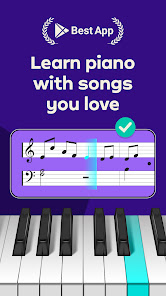
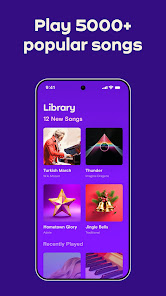
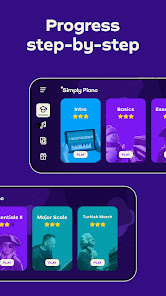
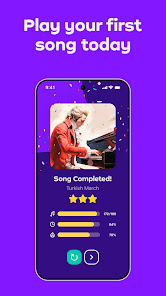
Simply Piano is a mobile app that listens through the device's microphone while a kid plays a real piano or keyboard, giving instant right-or-wrong feedback on each note. Lessons are split into a Soloist path (reading sheet music, playing melodies) and a Chords path, with five-minute practice sessions and popular songs as motivation. It's a solo tool — no teacher, no other students — designed to get beginners playing recognizable tunes quickly.
We've reviewed Simply Piano against our 9-literacy developmental framework. The main growth opportunity: Simply Piano is a note-matching tool, not a musicianship studio.
Full review
The NL Score measures developmental capacity-building, not product quality. A lower score doesn't mean a bad product. Simply Piano is a polished piano-learning app with real-time feedback and strong content. This score asks a different question: what capacities does it build?
Strengths & gaps
Strengths
- ● Simply Piano makes piano practice approachable. The app listens in real time, slows sections down, and gives immediate feedback while the child is at the keyboard.
- ● It does create a real practice habit. Five-minute workouts, repeated lessons, and song-based progression help kids come back often enough to build familiarity.
Gaps
- ○ Simply Piano is a note-matching tool, not a musicianship studio. Kids learn how to reproduce songs, but they do not improvise, compose, or make decisions about musical direction.
- ○ The product is narrow in the way it uses a child's effort. It teaches skill, but it doesn't connect that skill to identity, contribution, or shared musical life.
Detailed scores
How Simply Piano performs on each of the 9 literacies in our framework.
Doing
— 0 of 3 Strong
Simply Piano gives the child a guided sequence and expects them to follow it. They can move through songs and paths, but the app still decides what matters next. That means the child is practicing responsiveness more than ownership. It is useful structure, but not genuine self-directed action.
The app keeps the child practicing in small, repeatable loops. That matters in piano, where repetition is part of the work and progress comes from showing up again. But the app also smooths over difficulty. Reviews note limited rhythm judgment and inconsistent note recognition, so the child is not always pushed into deep productive struggle.
Every lesson is basically the same pattern. Watch, play, repeat, advance. That helps beginners stay oriented, but it does not ask them to notice a failed strategy and try something different. The app adapts for the child instead of training the child to adapt.
Thinking
— 0 of 3 Strong
Simply Piano closes questions quickly. It tells the child what note to play and when to play it, which leaves little room for inquiry. The library is broad, but breadth is not curiosity by itself. The child is selecting from arranged material, not exploring a musical unknown.
The app does not give the child a place to invent. There is no improvisation mode, no composition surface, and no open-ended musical canvas. That is a major ceiling for a piano-learning app. A child can become more capable, but not more creative inside the product itself.
Simply Piano evaluates performance against a fixed answer. That is not the same as weighing options, comparing evidence, or making a defensible decision. Because of that, Judgment is absent rather than merely weak. The app is about accuracy, not judgment.
Being
— 0 of 3 Strong
The app is built for solo practice. The family plan changes account management, not the social structure of the experience. There is no real collaboration, no peer learning, and no shared project. Connection is not what the product is for.
Piano practice does require waiting through frustration and staying with repetition. General music-training research also supports a link between active musical training and executive function or self-regulation. Still, Simply Piano keeps sessions short and heavily scaffolded. It encourages consistency, but it does not explicitly teach emotional control or impulse management.
Music can become part of identity, but Simply Piano does not help a child reflect on that. The app does not connect practice to values, community, or contribution. The official copy focuses on progress, songs, and convenience. That is enough for skill building, not purpose building.
Reviewed by New Literacies
Scored by our research-derived framework · AI-assisted analysis with editorial review · 0 sources reviewed · Our methodology →
Get the next guide before it goes live
One email when a new product review ships.
Free. No spam. Unsubscribe anytime.