Scratch Add-ons AI
Ages 5-16 · free · AI Product · scratch.mit.edu ↗
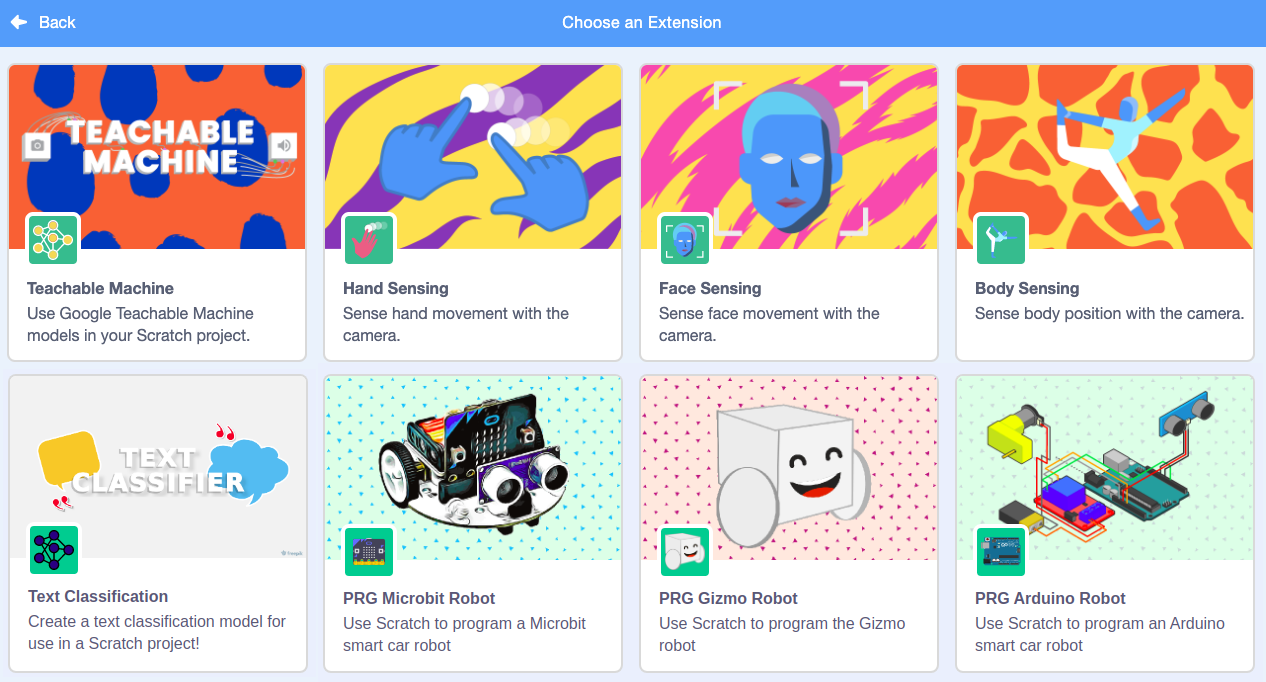
Scratch AI Extensions are a set of tools that let kids add machine learning and AI capabilities to their Scratch coding projects. Using MIT's RAISE AI Playground or Machine Learning for Kids, a child can train a model to recognize images, sounds, or text, then use visual code blocks to make that model do something in their project. A kid might train a model to recognize hand gestures, then program a game that responds to those gestures. Scratch's built-in Face Sensing extension lets kids make sprites respond to facial expressions.
Scratch Add-ons AI stands out for developmental impact across multiple literacies. It builds hands-on skills, cognitive skills. The main growth opportunity: connection is absent. These are solo coding tools. Social interaction depends entirely on the classroom or club context.
Strengths & gaps
Strengths
- ● Scratch AI Extensions put the child in complete control of an AI project. Kids choose what to build, collect training data, train models, and program behavior. This is agency and creativity at their strongest.
- ● Training ML models is a natural curiosity engine. The gap between "what I expected the model to do" and "what it actually did" creates constant investigation and surprise.
- ● Model training is inherently metacognitive. When a classifier fails, the child must reflect on why: was the training data biased? Were the categories wrong? Should I try a different approach? This builds adaptability.
Gaps
- ○ Connection is absent. These are solo coding tools. Social interaction depends entirely on the classroom or club context.
- ○ Self-regulation isn't addressed. Coding frustration exists but isn't scaffolded.
- ○ The "product" is an ecosystem of extensions, not a unified experience. Quality and developmental depth vary significantly depending on which tools a child uses and what projects they attempt.
Detailed scores
How Scratch Add-ons AI performs on each of the 9 literacies in our framework.
Doing
— 2 of 3 Strong
Scratch AI Extensions give the child complete authorship over their project. The child decides what AI will do, collects their own training data, trains the model, and programs how it behaves within their Scratch project. No prescribed path exists. Each project is the child's original creation with AI capabilities they designed.
Training ML models involves genuine difficulty. Models don't always classify correctly, training data needs iteration, and debugging requires sustained effort across multiple attempts. But difficulty is self-selected. Simple projects (Face Sensing with one sprite) can be completed quickly. Complex projects (multi-class image classifier integrated into a game) require real persistence.
ML model training is inherently metacognitive. When a model fails, the child must diagnose why and try a different approach: more training examples, different categories, different features. Each new project requires adapting prior knowledge to a new domain. The child constantly reflects on how the AI learns, not just what it produces.
Thinking
— 2 of 3 Strong
Scratch AI Extensions create genuine "why did it do that?" moments. Training a model to recognize cats and watching it misclassify a dog creates an information gap the child wants to close. The exploration space is vast: image recognition, text classification, gesture detection, language processing. Depth is available for kids who pursue it.
AI extensions add a new creative dimension to Scratch's already-creative environment. The child imagines AI-powered projects and builds them from scratch: gesture-controlled games, emotion-detecting art, voice-activated stories. Creative risk is constant because model behavior is unpredictable. Revision is natural to the workflow as projects evolve.
Training ML models exercises a specific type of judgment: Is my training data representative? Is the model accurate enough? Am I introducing bias? MIT's RAISE curriculum includes an AI ethics component. But ethical reasoning and real-world tradeoff evaluation aren't central to the tool experience.
Being
— 0 of 3 Strong
Solo coding activity. Scratch's community sharing platform exists, but social interaction during AI project creation depends on classroom or club context, not the tools themselves.
Coding frustration is real but not scaffolded. No emotion labeling, coping strategies, or regulation features.
AI projects can connect to genuine personal interests when a child builds something that matters to them. Scratch's sharing community lets children contribute projects others can learn from and remix. But purpose engagement is emergent, not designed into the tools.
Based on 7 sources
- Research media.mit.edu — ai blocks
- Research arxiv.org — 2505.03867v
- Research resources.scratch.mit.edu — ScratchLearningResource_ScratchAILesson.pdf
- Product dl.acm.org — 3626252.
- Product insideainews.com — book review machine learning for kids
- Product kidslab.dev — machine learning for kids with dale lane
- Product techclass4kids.com — does scratch have ai exploring new ai features in scratch lab and raise playground
Reviewed by New Literacies
Scored by our research-derived framework · AI-assisted analysis with editorial review · 7 sources reviewed · Our methodology →
Get the next guide before it goes live
One email when a new product review ships.
Free. No spam. Unsubscribe anytime.
See other products strong in the same literacies: