SayKid (ToyBot)
Ages 2-6 · paid · AI Product · toybot.com ↗
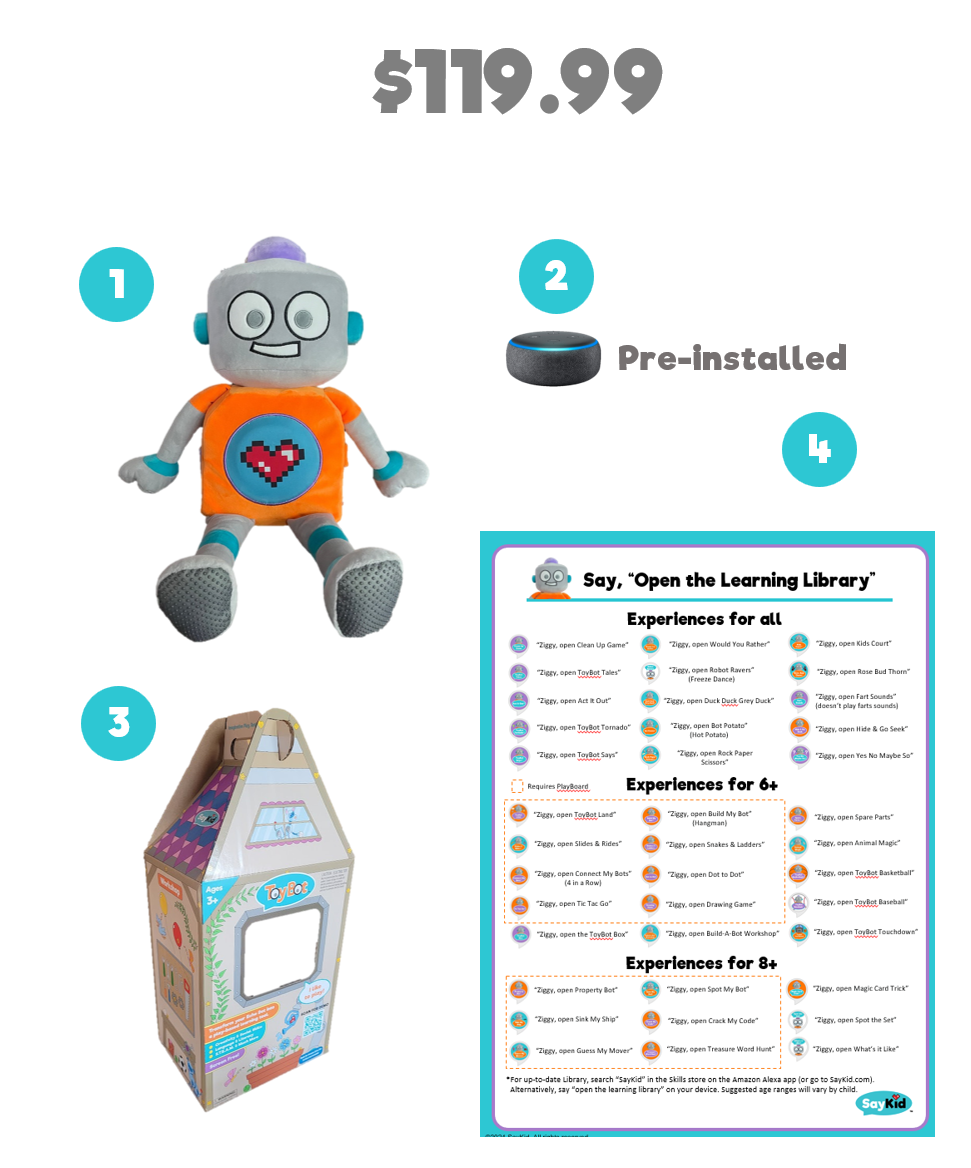

ToyBot is a soft plush robot that pairs hands-on play with Alexa-powered voice activities. The starter bundle includes the ToyBot, an Echo Dot, a physical PlayBox, and access to a library of games and story experiences. A child talks with the toy, plays guided games, and moves between voice prompts and physical play without using a screen.
We've reviewed SayKid (ToyBot) against our 9-literacy developmental framework. The main growth opportunity: the evidence base is weak. Most of what surfaced comes from SayKid's own materials plus one trade-style listing.
Strengths & gaps
Strengths
- ● ToyBot's best case is simple: it gets young children talking and playing without a screen.
- ● The voice-plus-physical format may support connection and curiosity better than a passive content toy.
- ● The "kids play the role of teacher" framing gives the child a more active role than many preschool learning products.
Gaps
- ○ The evidence base is weak. Most of what surfaced comes from SayKid's own materials plus one trade-style listing.
- ○ ToyBot looks broader than it is. The product offers many activities, but most appear tightly guided rather than deeply open-ended.
- ○ There is no strong evidence here for self-regulation, judgment, or purpose.
Detailed scores
How SayKid (ToyBot) performs on each of the 9 literacies in our framework.
Doing
— 0 of 3 Strong
ToyBot gives the child a speaking role and some decision-making power inside the game. The "play the role of teacher" framing is meaningful. But the structure is still heavily predefined by Alexa skills and activity scripts.
ToyBot seems designed for short, repeatable routines that can keep a younger child coming back. That's a useful persistence signal. But there isn't enough external reporting to say much more than that.
ToyBot offers lots of content. That doesn't automatically build adaptability. I didn't find evidence of children being pushed to shift strategies, transfer ideas, or rethink their approach in a substantial way.
Thinking
— 0 of 3 Strong
ToyBot's stories and conversational play can pull a child into the interaction. For preschool-age kids, that matters. But the product doesn't show the kind of open exploratory structure that would support a stronger curiosity rating.
ToyBot supports some imaginative play because it's plush, social, and story-oriented. Children can likely improvise around the prompts. But the core experiences still appear guided rather than truly open-ended.
The surfaced evidence doesn't show much evaluative thinking. ToyBot looks more like playful participation than a reasoning-heavy environment.
Being
— 0 of 3 Strong
ToyBot has a decent connection case because it is built around voice interaction and shared family play. But the current evidence base is too thin to call that a standout developmental strength.
There isn't much here for self-regulation beyond the usual turn-taking and attention demands of young-child play. I didn't find explicit emotional support or consistent reports of regulation gains.
ToyBot is a playful learning toy. The evidence doesn't support any claim about purpose.
Based on 5 sources
Reviewed by New Literacies
Scored by our research-derived framework · AI-assisted analysis with editorial review · 5 sources reviewed · Our methodology →
Get the next guide before it goes live
One email when a new product review ships.
Free. No spam. Unsubscribe anytime.