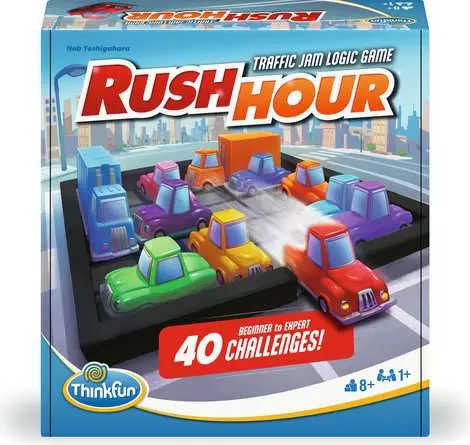
Rush Hour
Ages 8-14 · paid · Product · thinkfun.com ↗
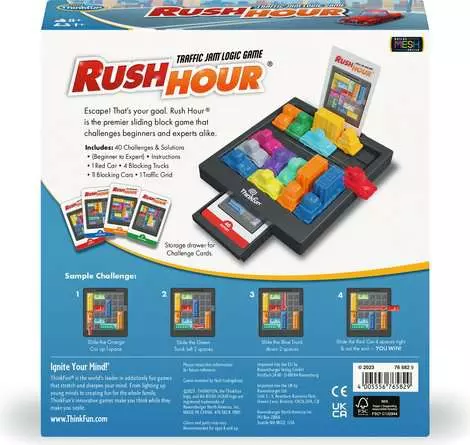
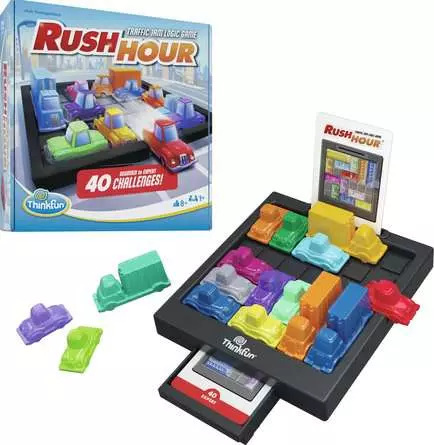
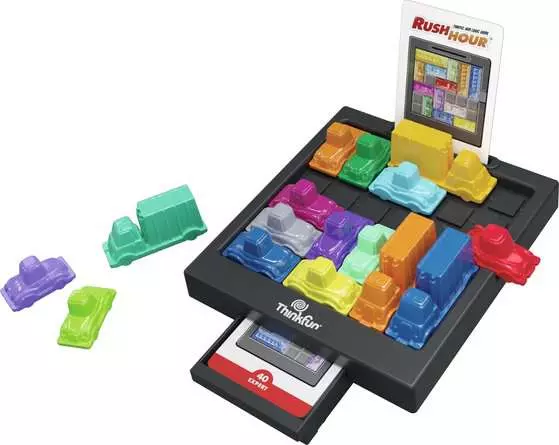
Rush Hour is a single-player sliding-block puzzle where kids move cars and trucks on a grid to free the red car from a traffic jam. The official set includes 40 challenge cards and printed solutions in the box. It is a physical game only, with no app or digital layer.
Rush Hour has focused developmental strength worth knowing about. It builds persistence. The main growth opportunity: Rush Hour does not build Connection on its own.
Strengths & gaps
Strengths
- ● Rush Hour is best for Persistence. The game keeps asking the child to try, back up, and try again.
- ● It builds practical judgment. Kids have to plan, test, and predict what each slide will do next.
- ● It works as a clean, low-noise challenge. Parents describe it as methodical and engaging rather than flashy.
Gaps
- ○ Rush Hour does not build Connection on its own. You can play it with someone, but the game does not require collaboration.
- ○ Creativity is narrow. The child invents move sequences, not original work.
- ○ Purpose is absent. The puzzle is satisfying, but it does not connect effort to real-world meaning.
Detailed scores
How Rush Hour performs on each of the 9 literacies in our framework.
Doing
— 1 of 3 Strong
Rush Hour gives kids real choice in how they solve the board. The red car has to escape, but there are many ways to work toward that goal. The child is acting, not just answering, which is enough for Moderate rather than Limited.
Rush Hour is built around productive struggle. The official game includes 40 challenges, and the included solutions let kids try first and check later. Reviews describe it as addictive and methodical, which matches the way the puzzle rewards repeated effort over time.
The child has to revise the plan when one sequence locks the board. A useful move now may only work after several setup moves, so the child learns to adjust course rather than repeat the same action. But the game stays inside one fixed puzzle format, so the capacity stays Moderate.
Thinking
— 0 of 3 Strong
Rush Hour creates a simple question that kids want to answer: how does this jam open up? The fixed challenge cards and visible board state make it easy to test ideas and see what happens. That gives it enough exploratory pull to score Moderate.
Rush Hour rewards clever sequencing, but it does not ask kids to create something new. There is no blank canvas, no story, and no artifact to revise. The child solves a puzzle instead of expressing an original idea.
Rush Hour asks kids to evaluate options and predict consequences before they move. They have to decide which slide creates more room later, not just what looks good now. That is real judgment, but only inside a narrow logic domain.
Being
— 0 of 3 Strong
Rush Hour is a solo puzzle, so it does not naturally build communication or belonging. Families can talk through the challenge, but that comes from the setting around the game, not from the game itself. Connection stays outside the product scope.
Rush Hour is frustrating in the useful way. Kids have to sit with being stuck and keep going long enough to get unstuck. The game does not teach coping skills, but it does create a real chance to practice them.
Rush Hour is about solving a traffic jam. It does not tie the work to identity, values, or contribution. That makes Purpose outside the product's scope.
Based on 6 sources
Reviewed by New Literacies
Scored by our research-derived framework · AI-assisted analysis with editorial review · 6 sources reviewed · Our methodology →
Personalization bridge
Not sure what your kid needs most?
Take the quiz to see which literacies matter most for your family, then get practical things to try at home.
Get your family profileExplore more
See other products strong in the same literacies: