
Robot Turtles
Ages 4-8 · paid · Product · thinkfun.com ↗
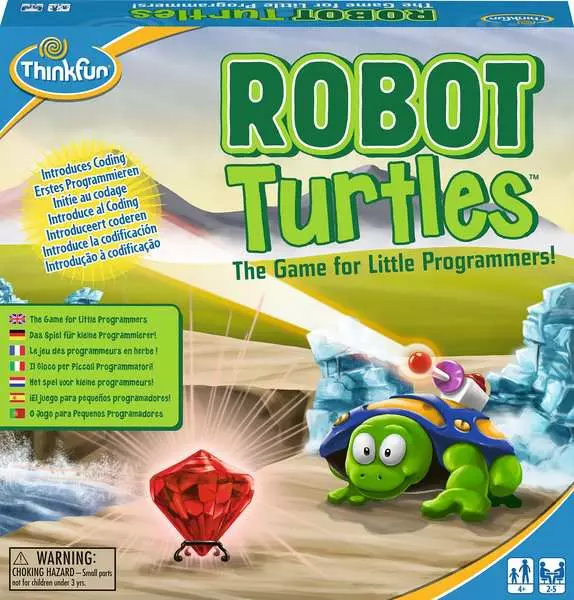
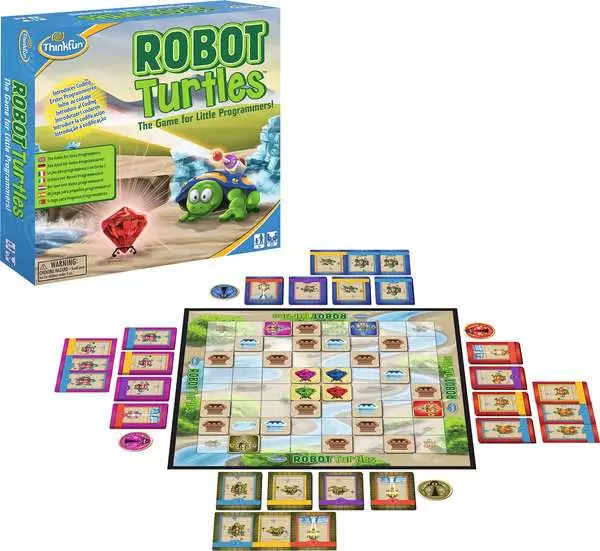
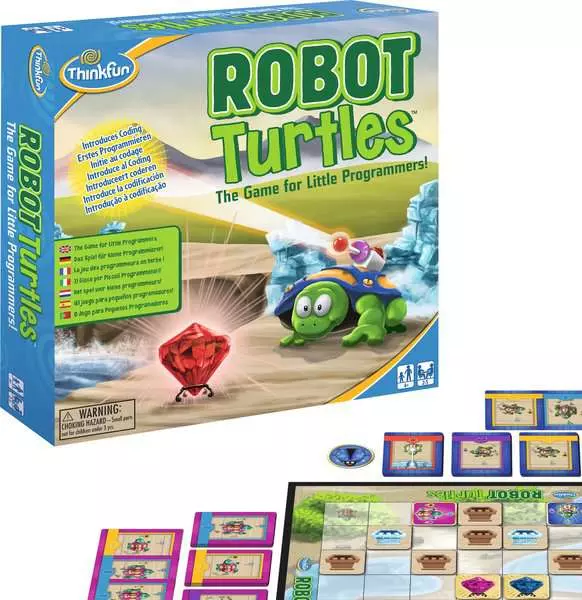
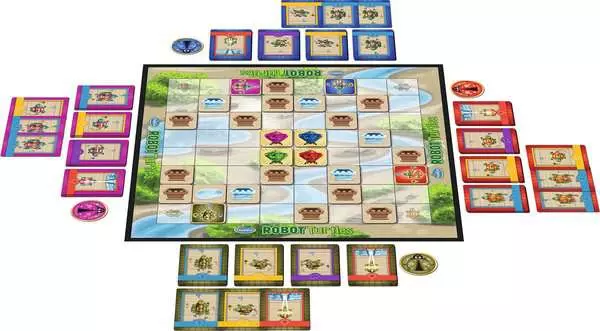
Robot Turtles is a screen-free board game where preschoolers lay down Code Cards — forward, turn left, turn right — to guide a turtle across a grid toward a jewel, while an adult sits across the table and physically moves the turtle piece exactly as the cards say. When a sequence goes wrong, the kid slaps down a Bug Card, the adult undoes the last move, and they try again. As kids get the hang of it, the game adds ice walls, lasers to melt them, and a Function Frog card that introduces the idea of reusable instructions.
Robot Turtles has focused developmental strength worth knowing about. It builds agency, connection. The main growth opportunity: curiosity stays narrow. Once the card set and maze rules are familiar, there isn’t much left to discover.
Strengths & gaps
Strengths
- ● Robot Turtles is strongest when a child wants to feel in charge. The child writes the cards, the adult follows them, and the Bug Card turns mistakes into another try.
- ● Connection is built into the design. A parent has to sit at the table as the Turtle Mover, so the game becomes one-on-one time instead of parallel play.
- ● It introduces real coding language early. Kids learn sequencing, order of operations, and debugging with their hands, not a screen.
Gaps
- ○ Curiosity stays narrow. Once the card set and maze rules are familiar, there isn’t much left to discover.
- ○ Creativity is limited by design. The game asks for correct sequences, not original ideas.
- ○ Older kids may outgrow it quickly. The strongest fit is preschool and kindergarten.
Detailed scores
How Robot Turtles performs on each of the 9 literacies in our framework.
Doing
— 1 of 3 Strong
Robot Turtles gives the child the wheel. They lay down the cards, decide the sequence, and watch the adult execute the plan exactly as written. The parent does not solve the puzzle for them. The Bug Card matters here. It lets the child undo a bad move and try again without losing ownership of the process. That is real initiation and real feedback.
The game does ask kids to keep trying when a route fails. The official page adds obstacles and more complex cards as players advance, so there is some built-in retry pressure. But Robot Turtles is still a short board game. The challenge is real, but it is not deep or sustained enough to count as Strong persistence.
Robot Turtles builds debugging into the loop. When a sequence sends the turtle the wrong way, the child has to rethink and try a different ordering of cards. The game also adds lasers, ice walls, and the Function Frog as it gets harder. But the move space stays small, so this is adaptation inside one tight system.
Thinking
— 0 of 3 Strong
Robot Turtles teaches a concept cleanly, then mostly ends there. The board is closed, the rules are fixed, and the syntax is simple enough that children master it quickly. The reviews describe it as educational and fun, but not as a game that keeps opening new questions. That keeps curiosity at Limited.
The child is not making something original. They are arranging movement instructions on a fixed board to reach a jewel. That is good programming practice, but it is not open-ended creation. The game gives structure, not a blank canvas.
Robot Turtles targets preschoolers and early elementary children. That is the right age to start sequencing and debugging, but not the right age to score broader evaluative judgment here. The game can support later thinking, but that is not the same as the child independently weighing evidence or tradeoffs.
Being
— 1 of 3 Strong
Robot Turtles requires a parent or other adult to play the Turtle Mover role. That makes the game inherently social and keeps the child in direct contact with another person. Reviewers consistently describe it as a good parent-child game. The design turns coding into a shared table experience.
The Bug Card normalizes mistakes. That helps kids recover from frustration without feeling punished. Still, Robot Turtles does not teach regulation strategies directly. It gives practice, not instruction.
The game is about learning programming basics. It does not connect that work to identity, values, or contribution. For this age group, that is fine. Purpose is simply not the main developmental job here.
Based on 9 sources
- Product link.springer.com — s10643 025 01930 x
- Research iro.uiowa.edu —
- Product techcrunch.com — robot turtles
- Product screenwiseapp.com — robot turtles boardgame
- Product play-board-games.com — robot turtles board game review
- Product dicetower.com —
- Product findmykids.org — robot turtles
- Product ravensburger.us — robot turtles
- Product thinkfun.com — legal notice
Reviewed by New Literacies
Scored by our research-derived framework · AI-assisted analysis with editorial review · 9 sources reviewed · Our methodology →
Personalization bridge
Not sure what your kid needs most?
Take the quiz to see which literacies matter most for your family, then get practical things to try at home.
Get your family profileExplore more
See other products strong in the same literacies: