
Reading.com
Ages 3-9 · paid · Product · reading.com ↗
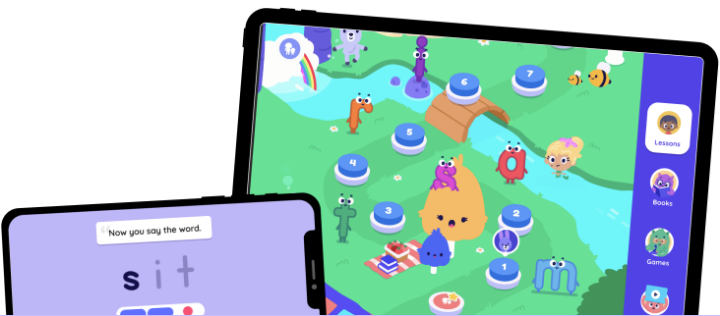
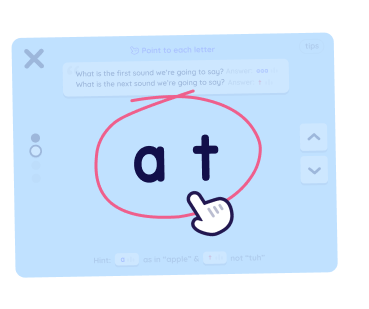
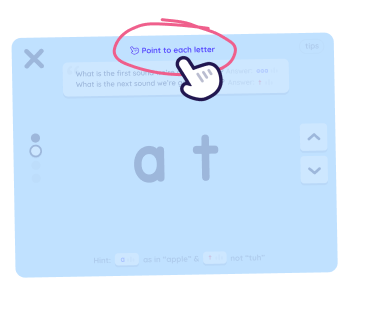
Reading.com is a structured phonics program with 99 scripted lessons that a parent and child work through together. Each 15–20 minute session covers letter sounds, blending practice, and co-reading decodable books where pictures stay hidden until after the child decodes the words. The parent follows an on-screen script guiding exactly what to say and do, making it accessible to caregivers with no teaching background.
Reading.com has focused developmental strength worth knowing about. It builds connection. The main growth opportunity: Reading.
Strengths & gaps
Strengths
- ● Reading.com's standout feature is its parent-child co-learning design. Every lesson is a shared activity, building reading rituals and bonding time. Research cited by the app suggests children are 19x more likely to learn from an app when guided by a parent.
- ● Reading.com's clearest developmental strength is Connection. The product is built around a parent and child reading together, talking through the script, and returning to a shared routine over time.
- ● The 99-lesson arc builds Persistence through sustained engagement. Families return daily over months, and app store reviewers report children who started uninterested became confident independent readers.
Gaps
- ○ Reading.com doesn't build Agency, Curiosity, or Creativity. The Direct Instruction model is designed to eliminate ambiguity and prescribe every step. That's effective pedagogy for phonics, but it means the child never sets goals, explores, or creates.
- ○ Self-Regulation is not developed. The careful scaffolding prevents frustration rather than creating manageable challenge. Kids who already struggle emotionally won't find regulation practice here.
Detailed scores
How Reading.com performs on each of the 9 literacies in our framework.
Doing
— 0 of 3 Strong
Reading.com follows the Direct Instruction model. The parent reads a script, the child follows it. Lessons proceed in fixed order, responses have one correct answer, and the child never initiates or chooses. Phonics.org notes the app requires "competent adult supervision" throughout.
Reading.com builds gradually across 99 lessons, and the one-lesson-per-day pacing encourages families to return over weeks and months. The hidden-picture feature forces actual decoding rather than guessing, creating some productive effort. But the DI model carefully manages difficulty to prevent frustration. Challenge exists but is deliberately gentle.
Every lesson follows the same structure: letter instruction, blending, co-reading, games. One app store reviewer noted the approach doesn't evolve past CVC words into broader phonics rules. The child applies the same decode-and-blend strategy from lesson 1 to lesson 99.
Thinking
— 0 of 3 Strong
Reading.com delivers phonics knowledge directly. No information gaps are created. No exploration is possible. The child never asks questions or follows tangents. The engaging format keeps kids interested, but engagement is not the same as curiosity.
Activities include tracing letters, articulating sounds, and decoding words. Every response has a predetermined correct answer. No original creation, no open-ended expression, no "what if" moments.
Phonics instruction involves no evaluation, decision-making, or analytical reasoning. For ages 3–8, Judgment requires analytical content to score. Reading.com has none. Outside the product's scope.
Being
— 1 of 3 Strong
Reading.com is built around a real parent-child reading partnership. The scripted format still leaves room for turn-taking, encouragement, correction, and shared attention, and the product explicitly frames that teamwork as the point. This is more than "a parent can help if they want to." Reading.com turns family reading into the core loop, which is enough to make Connection its standout literacy.
The DI model's strength is preventing confusion and frustration through careful scaffolding. That's the opposite of creating the manageable emotional challenge that builds self-regulation. No emotion labeling, no coping strategies, no delayed gratification structure.
Reading.com teaches a technical skill. It doesn't connect reading to identity, values, or contribution. Purpose is outside its scope.
Based on 7 sources
- Product phonics.org — reading dot com app review
- Product learningreadinghub.com — reading com app review learn read phonics
- Product pastory.app — is reading com good and safe for kids
- Product apps.apple.com — id
- Product play.google.com — details
- Product totschoolresources.com — reading com app review
- Product brighterly.com — best reading apps for kids
Reviewed by New Literacies
Scored by our research-derived framework · AI-assisted analysis with editorial review · 7 sources reviewed · Our methodology →
Get the next guide before it goes live
One email when a new product review ships.
Free. No spam. Unsubscribe anytime.
See other products strong in the same literacies: