
Prodigy Math
Ages 6-14 · freemium · Curriculum · prodigygame.com ↗
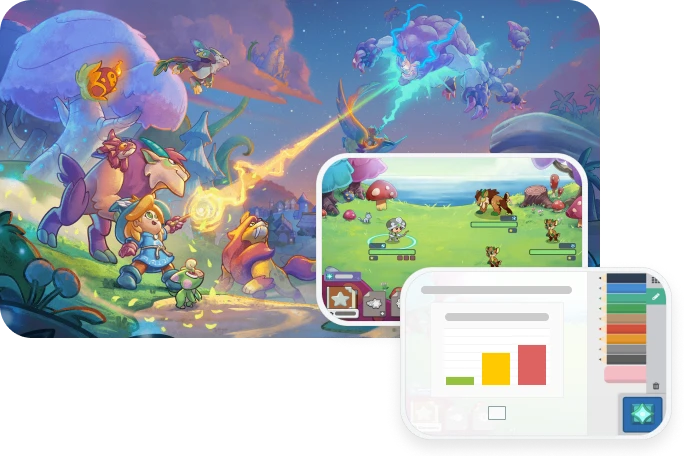


Prodigy Math wraps curriculum-aligned math questions in a fantasy RPG. Kids answer problems to cast spells, win battles, unlock pets, and level up their wizard. It is one of the clearest examples of a math-practice product where the game shell is doing most of the motivational work.
We've reviewed Prodigy Math against our 9-literacy developmental framework. The main growth opportunity: Most of Prodigy's developmental gaps are structural, not accidental.
Strengths & gaps
Strengths
- ● Prodigy's real strength is engagement. It gets many children to voluntarily spend time on math practice they would otherwise avoid.
- ● The adaptive system and hint structure do create some Persistence signal. Kids often keep going because the game layer makes repeat effort feel worthwhile.
Gaps
- ○ Most of Prodigy's developmental gaps are structural, not accidental. The product is built around rewards, not self-direction, curiosity, or creation.
- ○ Premium pressure and comparison features also make it harder to call this healthy self-regulation practice. The strongest motivational signals come from the game's economy, not from the math.
Detailed scores
How Prodigy Math performs on each of the 9 literacies in our framework.
Doing
— 0 of 3 Strong
Prodigy gives the child things to click on and customize. It does not give them meaningful control over the purpose or direction of the experience. The system's loop drives everything.
Prodigy can get kids to keep going. The adaptive challenge and reward cycle are effective at sustaining use. But the persistence is often game-powered rather than built through deep productive struggle.
The visual setting changes, but the cognitive demand stays similar. Prodigy rarely asks the child to rethink how they learn or solve problems.
Thinking
— 0 of 3 Strong
The main questions children ask in Prodigy are usually about the next pet, zone, or reward. The product does not strongly open mathematical rabbit holes.
Prodigy offers customization but not creation. Kids decorate and collect. They do not build something new.
There is very little real judgment in the system. Most math is right-or-wrong, and most game choices are shallow.
Being
— 0 of 3 Strong
Prodigy's light social layer is not enough to count as connection-building. Collaboration and perspective-taking are not central to the experience.
Prodigy uses a lot of immediate reward. That makes it hard to argue it builds delayed gratification well. The premium tension makes this worse.
The child's effort mainly serves Prodigy's own progression system. It does not strongly connect the work to identity, values, or contribution.
Based on 4 sources
- Review commonsense.org — prodigy math
- Review commonsense.org —
- Product prodigygame.com
- Product axios.com — prodigy math game ftc complaint
Reviewed by New Literacies
Scored by our research-derived framework · AI-assisted analysis with editorial review · 4 sources reviewed · Our methodology →
Get the next guide before it goes live
One email when a new product review ships.
Free. No spam. Unsubscribe anytime.