Prime Climb
Ages 8-14 · paid · Product · mathforlove.com ↗
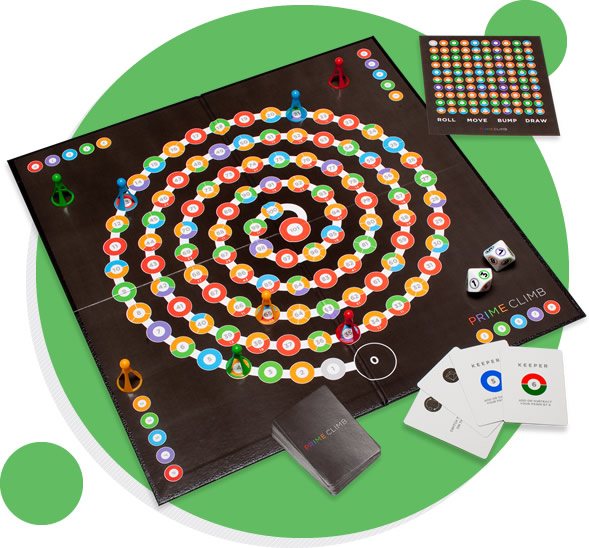
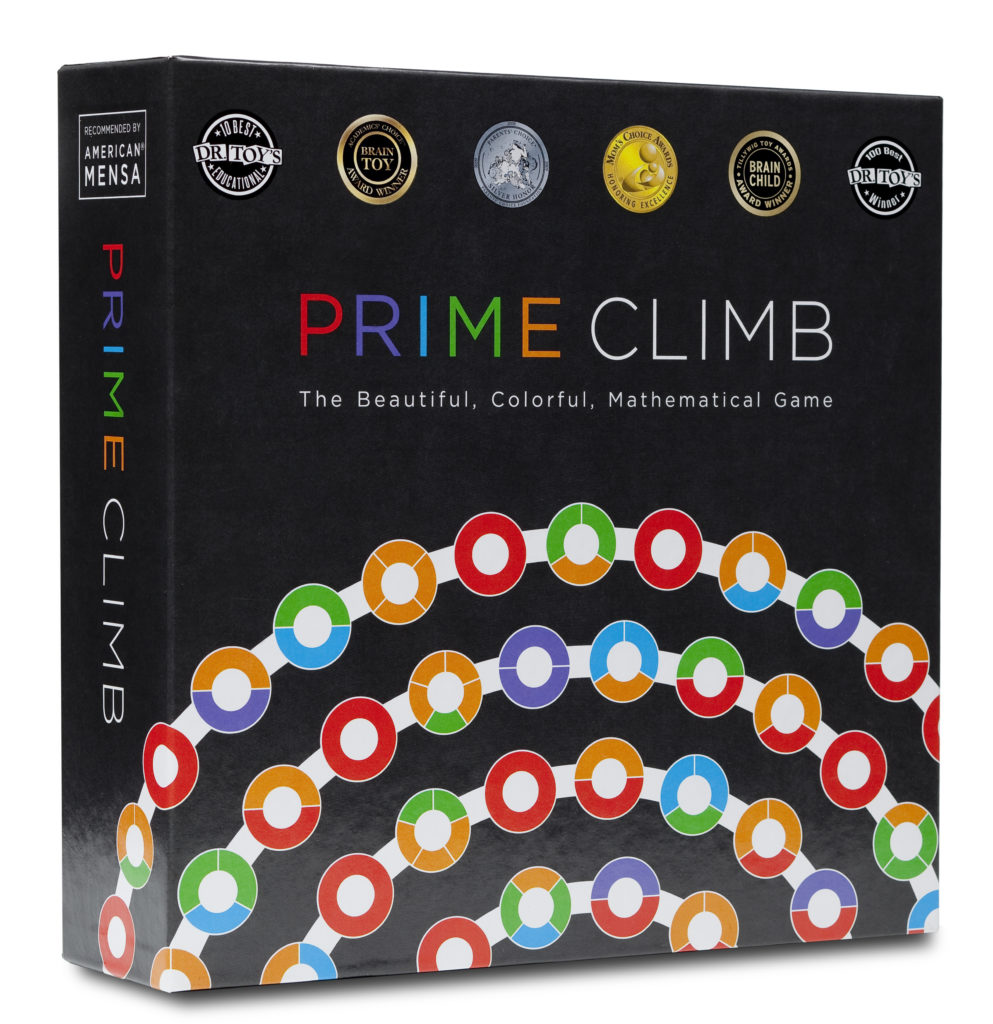

Prime Climb is a 2-4 player board game where kids roll two 10-sided dice, then choose how to add, subtract, multiply, or divide their way along a number track to 101. The board is color-coded by prime factors — every number's color shows its structure — so kids start noticing patterns in multiplication and divisibility just by looking at where they're headed. Players can bump each other back and collect Prime Cards for bonus moves, which turns each roll into a real strategic decision.
Prime Climb has focused developmental strength worth knowing about. It builds cognitive skills. The main growth opportunity: creativity stays limited. Prime Climb rewards finding the best move, not making something original.
Strengths & gaps
Strengths
- ● Prime Climb is unusually strong for Curiosity in a math game. The color-coded board turns prime factors into visible structure, so kids see patterns instead of just memorizing facts.
- ● It is also strong for Judgment. Every turn asks the child to weigh speed, safety, bumping, and card timing, which makes the game feel like strategy rather than drill.
- ● The game is friendly to families and classrooms. It plays face-to-face, moves quickly, and still leaves room for real mathematical discussion.
Gaps
- ○ Creativity stays limited. Prime Climb rewards finding the best move, not making something original.
- ○ The game doesn't teach self-regulation directly. Kids have to handle frustration from bad rolls and knock-backs on their own.
- ○ Purpose is not part of the design. Prime Climb builds number sense and strategy, not identity or contribution.
Detailed scores
How Prime Climb performs on each of the 9 literacies in our framework.
Doing
— 0 of 3 Strong
Prime Climb gives kids real control over the move they make on each turn. They choose the operation, decide whether to move one pawn or both, and can often find more than one valid path forward. But the goal is fixed, the board is fixed, and the dice decide the starting point for every move. That keeps the experience clearly below Strong. The child is steering, but not setting the destination.
The game creates real setbacks. A good position can disappear when an opponent bumps a pawn back to Start, and the Mike's Math Page review captures that swingy, "wild" feeling well. Kids have to recover and keep playing. Still, the difficulty is partly luck-driven. The game asks for return effort, but it doesn't consistently stretch persistence the way a harder, more calibrated system would.
Every roll changes the situation, so kids can't run the exact same move every time. The teaching materials even frame the game around prompts like "What do you notice?" and "What do you wonder?" because the board invites active adjustment and pattern reading. But the strategy space is narrow. Players are still doing arithmetic toward 101, so this is tactical adaptation inside one framework rather than broad transfer across different contexts.
Thinking
— 2 of 3 Strong
Prime Climb's board is built to make children ask questions. The colors show prime factors directly, and Junaid Mubeen describes the grid as "enthralling, mystifying and revelatory." That is what good curiosity fuel looks like. The game creates real information gaps. Kids want to know why one number looks the way it does and how the color patterns connect.
Prime Climb is an optimization game. The child is trying to find the best move within fixed arithmetic rules, not inventing a new artifact or original idea. The classroom puzzle extensions are interesting, but they sit outside the core game. That makes Creativity narrow. The product supports mathematical thinking, not open-ended creation.
This is where Prime Climb really works. Every turn forces a tradeoff: advance quickly, protect a pawn, bump an opponent, or hold a Prime Card for later. The Smarter Learning Guide and Engaged Family Gaming both frame the game as decision-making with real strategic depth. The child is evaluating options, predicting outcomes, and choosing under uncertainty. That's exactly the kind of reasoning the rubric treats as Strong.
Being
— 0 of 3 Strong
Prime Climb is a face-to-face game, so it naturally creates shared attention and direct interaction. The bumping mechanic makes players react to one another instead of just playing side by side. But it does not require collaboration or negotiation. Connection happens because people are gathered around the board, not because the game needs them to work together.
The game produces real frustration. Getting sent back to Start after a good roll is emotionally loud for kids, and that can create useful practice in staying with the game instead of quitting. Prime Climb doesn't teach coping strategies, though. It creates the conditions for regulation practice without explicitly scaffolding the skill.
Prime Climb is about math structure and strategy. It doesn't try to connect effort to identity, values, or contribution. That means Purpose isn't really in scope here. The game can be fun and meaningful without building that capacity directly.
Based on 8 sources
- Product mathforlove.com — prime climb
- Product mathforlove.com — how to play
- Product mathforlove.com — teach with prime climb
- Product mathforlove.com — prime climb rules for younger players
- Product fjmubeen.medium.com — prime climb where mathematics meets play e78c09e337f
- Product smarterlearningguide.com — prime climb review
- Product engagedfamilygaming.com — board game review primo
- Product mikesmathpage.wordpress.com — a review of prime climb by math for love
Reviewed by New Literacies
Scored by our research-derived framework · AI-assisted analysis with editorial review · 8 sources reviewed · Our methodology →
Personalization bridge
Not sure what your kid needs most?
Take the quiz to see which literacies matter most for your family, then get practical things to try at home.
Get your family profileExplore more
See other products strong in the same literacies: