Pastory
Ages 2-12 · freemium · AI Product · pastory.app ↗




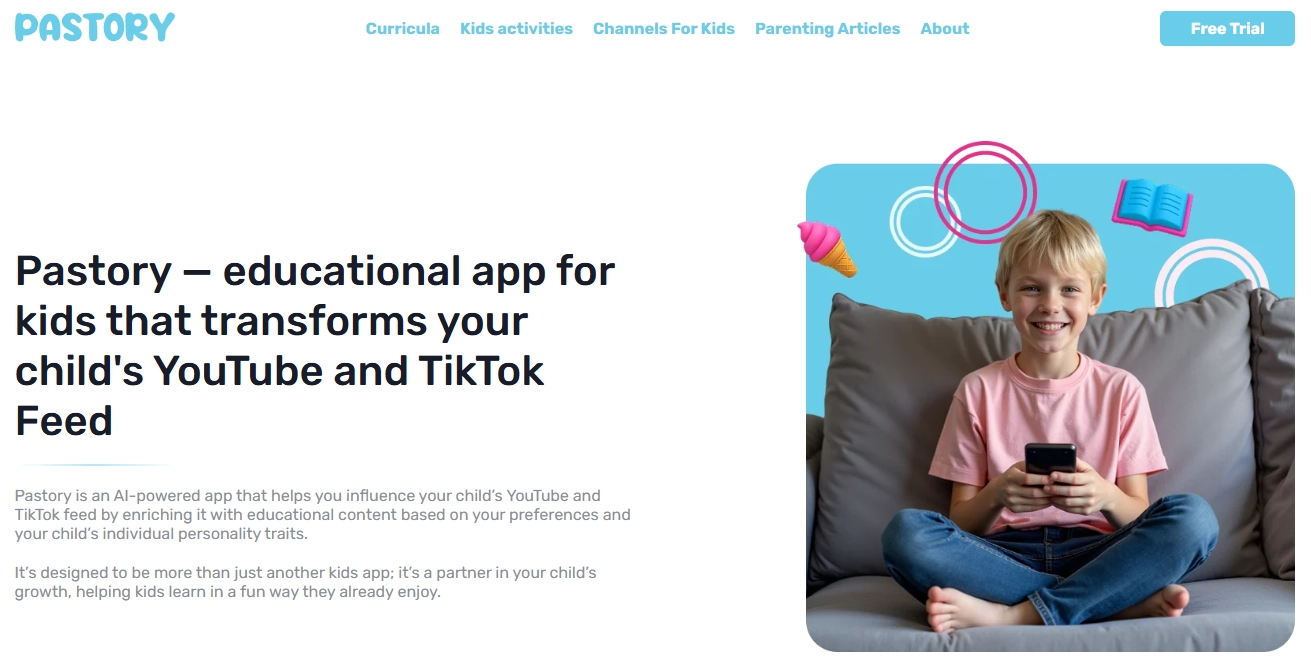
Pastory is an AI-curated educational content platform that tries to turn mainstream video habits into something more structured. Parents choose topics and constraints, then children get age-banded educational video streams plus follow-on offline activities tied to what they watched.
We've reviewed Pastory against our 9-literacy developmental framework. The main growth opportunity: Pastory is still built around curated consumption first.
Strengths & gaps
Strengths
- ● Pastory's best move is trying to bridge screen content into offline activity. That gives it more developmental texture than a plain curated feed.
- ● Self-regulation also gets a modest boost from stronger parent controls and a clearer "less junk" stance than open video platforms.
Gaps
- ○ Pastory is still built around curated consumption first. The child mostly watches content selected by the system and parent settings.
- ○ Creativity is only moderate because the making layer is an extension, not the main event.
- ○ Confidence is limited by the lack of independent reviews or learning studies.
Detailed scores
How Pastory performs on each of the 9 literacies in our framework.
Doing
— 0 of 3 Strong
Pastory lets children follow interest areas inside a bounded system. That gives them more room than a fixed playlist. But parents and the AI curation layer still shape the experience first.
Pastory tries to keep a child on one learning thread longer through curricula and follow-on activities. That can extend engagement beyond a single clip. The evidence is still mostly company-authored.
The platform personalizes around age and interests, which makes the feed more responsive than a one-size-fits-all catalog. That is useful. It does not require much active strategy change from the child.
Thinking
— 0 of 3 Strong
Pastory can widen topical exposure through safer discovery. That is better than endless undirected scrolling. But the child still stays in a curated content loop.
The offline activity layer matters. It turns some video watching into craft, play, or applied activity. That is a real improvement over passive streaming, even if it is not the product's center of gravity.
Pastory gives children a better set of choices than an open social video feed. That helps. But most of the real discernment work is still handled by the parent and the curation system.
Being
— 0 of 3 Strong
Pastory can invite more shared use because parents help set the path and offline activities can happen together. That is meaningful. It is still not a deeply relational product.
Pastory earns some credit by reducing junk and building a path out of pure passive scrolling. The offline bridge strengthens that case. It remains a screen-based content platform, so the ceiling stays moderate.
Pastory is built around safer, more educational media use. It does not strongly connect activity to identity, contribution, or values.
Based on 4 sources
- Product pastory.app
- Product pastory.app — top ai apps for kids
- Product pastory.app — screen free activities for kids
- Product pastory.app — privacy policy
Reviewed by New Literacies
Scored by our research-derived framework · AI-assisted analysis with editorial review · 4 sources reviewed · Our methodology →
Get the next guide before it goes live
One email when a new product review ships.
Free. No spam. Unsubscribe anytime.