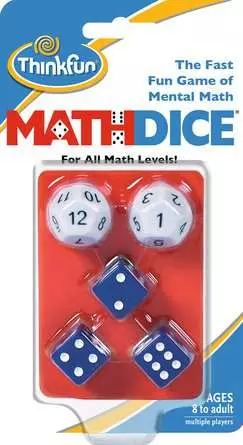
Math Dice
Ages 8-14 · paid · Product · thinkfun.com ↗
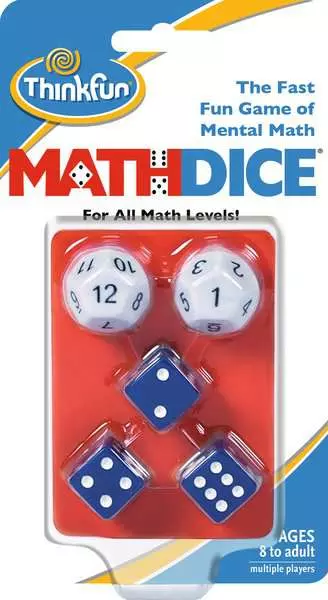
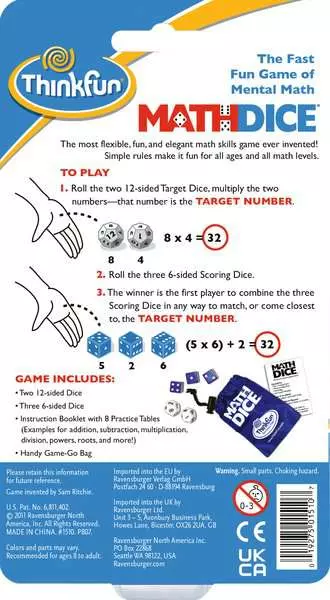
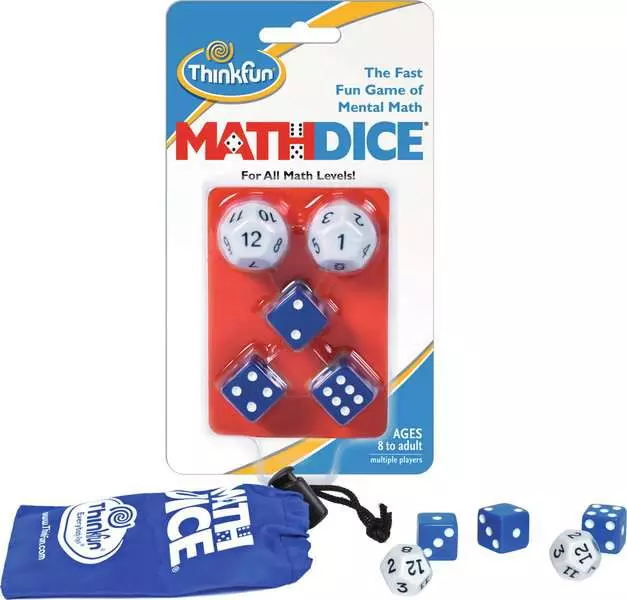
Math Dice is a quick mental-math game built around one small challenge: use a few rolled numbers to get as close as possible to a target. Kids test equations in their head, compare approaches, and try again next round with a new set of numbers. It feels more like a puzzle sprint than a worksheet.
Math Dice has focused developmental strength worth knowing about. It builds persistence, judgment. The main growth opportunity: the domain is narrow. Almost all of the developmental value stays inside arithmetic problem-solving.
Strengths & gaps
Strengths
- ● Math Dice is strongest for Persistence and Judgment. The child has to keep working the same numbers until a better path appears.
- ● Multiple valid solutions matter. That gives the game more flexibility than drill-based math practice.
- ● The format is short and replayable. Kids get many rounds of effort without the emotional drag of a long worksheet.
Gaps
- ○ The domain is narrow. Almost all of the developmental value stays inside arithmetic problem-solving.
- ○ Creativity is present, but constrained. Kids are inventing equations, not building something larger or more expressive.
- ○ Connection depends on how the table plays. The game supports math talk, but does not require rich interaction.
Detailed scores
How Math Dice performs on each of the 9 literacies in our framework.
Doing
— 1 of 3 Strong
Math Dice gives kids control over method. They cannot choose the numbers, but they can decide how to combine them and which equation path to chase first. That makes the child an active solver, not just a responder. Still, the overall challenge is tightly framed, so Agency stays Moderate.
This game keeps kids in the fight. The most common experience is not instant success. It is getting close, trying another operation, and squeezing one more idea out of the same dice. Because the rounds are short and failure is low-stakes, kids can stay with difficulty without feeling punished. That is strong persistence practice.
Every roll changes the problem. Kids have to abandon the last round’s pattern and adjust to a new target with new operands. But the underlying task remains the same kind of number puzzle each time. Adaptability is real, just narrow.
Thinking
— 1 of 3 Strong
Math Dice can spark the useful math question: "Is there another way to get there?" That is a genuine curiosity loop, and the game’s multiple-solution structure supports it. But the curiosity stays inside arithmetic exploration. It does not open into a wider inquiry space.
There is real invention in finding unusual equations from the same few dice. Kids can surprise themselves and each other with elegant solutions. But the numbers and operations create hard limits. This is bounded mathematical creativity, not open-ended creation.
Judgment is at the center of good play. A child has to compare possible paths, estimate which one is most promising, and decide whether to settle for close or keep pushing for exact. That repeated weighing of options is what makes Math Dice better than a simple flash-card game.
Being
— 0 of 3 Strong
Math Dice can produce strong math talk when kids compare strategies aloud or solve together. That social layer is valuable. But it is optional rather than built into the core mechanic, so Connection stays moderate.
Kids have to keep thinking when the obvious answer fails. That means tolerating frustration, dropping a weak path, and trying another one without spiraling. The emotional demand is real, but light enough to stay manageable.
Math Dice does not connect math effort to identity, service, contribution, or larger meaning. It is a smart challenge game, not a purpose-building tool.
Based on 5 sources
- Product wired.com — toy fair math dice
- Product mathforlove.com — math dice
- Product mathpickle.com — math dice
- Product boardgamegeek.com — math dice
- Product parentsasteachers.org — math dice by thinkfun
Reviewed by New Literacies
Scored by our research-derived framework · AI-assisted analysis with editorial review · 5 sources reviewed · Our methodology →
Personalization bridge
Not sure what your kid needs most?
Take the quiz to see which literacies matter most for your family, then get practical things to try at home.
Get your family profileExplore more
See other products strong in the same literacies: