
Mastermind
Ages 8-14 · paid · Product · pressmantoy.com ↗
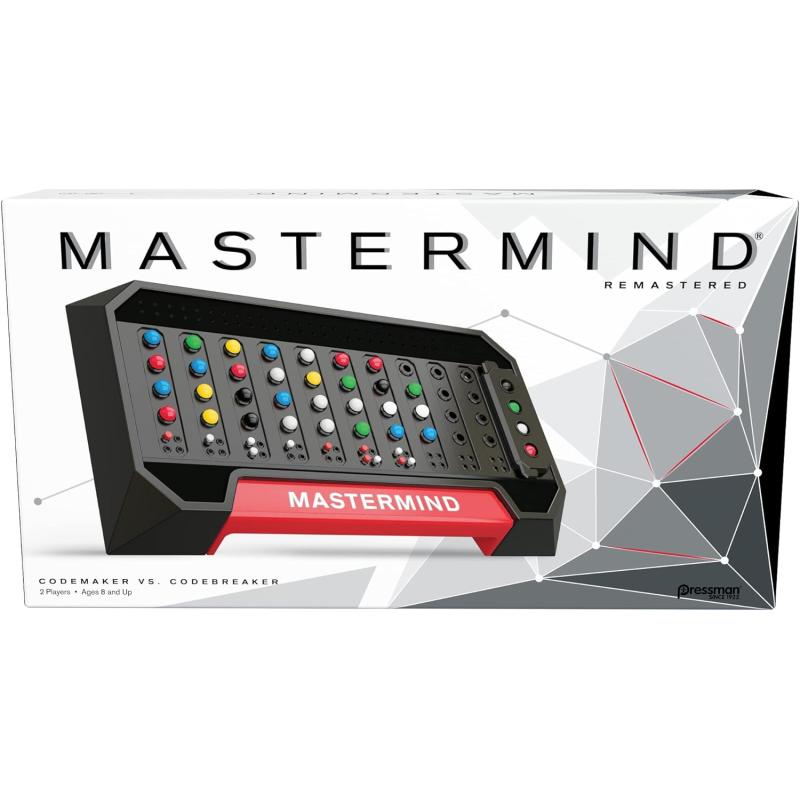
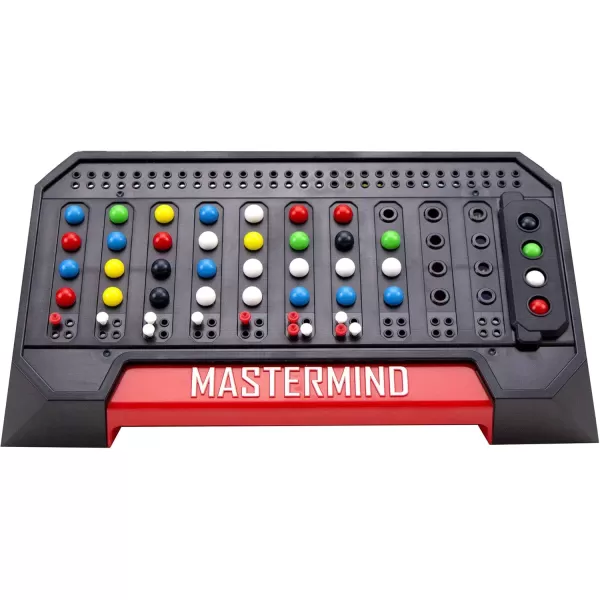
Mastermind is a two-player code-breaking game. One player hides a four-color code and the other tries to crack it using feedback pegs after each guess. The official Pressman page frames it as a fast, simple strategy game with more than 2,000 possible combinations.
Mastermind has focused developmental strength worth knowing about. It builds judgment. The main growth opportunity: mastermind does not build Purpose. It stays focused on the puzzle itself.
Strengths & gaps
Strengths
- ● Mastermind's clearest strength is Judgment. The child is constantly testing a hypothesis, reading feedback, and revising the next guess.
- ● It is easy to play but not easy to solve. That balance makes it a clean logic challenge for kids who like mental puzzles.
- ● The game has a real back-and-forth. The code-maker gives clues, the code-breaker reacts, and then the roles switch.
Gaps
- ○ Mastermind does not build Purpose. It stays focused on the puzzle itself.
- ○ Creativity is narrow. The child makes moves inside a closed system instead of building something original.
- ○ Connection is limited. The game is social, but it is still mostly an exchange of clues and competition.
Detailed scores
How Mastermind performs on each of the 9 literacies in our framework.
Doing
— 0 of 3 Strong
Mastermind gives the child real choice on every turn. They decide which guess to make next and, when they are the codemaker, which code to hide. But the goal is fixed by the rules, so this is bounded agency rather than self-directed play.
The child has to keep trying when the code does not crack right away. That creates useful practice with sticking to a task. But the game is short and tightly structured, so it does not become a deep persistence builder.
Each clue changes what the next guess should be. The child has to back up, refine, and try again. The structure is always the same, though, so the adaptation stays inside one puzzle system.
Thinking
— 1 of 3 Strong
The hidden code creates a clear information gap. The child wants to know what is behind the shield and uses clues to narrow the field. That makes the game curious, but not exploratory beyond the puzzle.
Mastermind rewards clever guesswork, but it does not ask the child to make something new. There is no artifact, no open canvas, and no revision cycle for original work. It is a deduction game first.
This is the game's main value. The child uses evidence from each clue to rule things in and out, then chooses the next move based on that reasoning. The PLoS Biology article shows why the game maps cleanly to hypothesis-testing and experimental design.
Being
— 0 of 3 Strong
Mastermind is played face-to-face, so the child is interacting with another person, not a screen. The codemaker and codebreaker have a real exchange of clues and responses. But the interaction is mostly competitive, so it does not become a strong connection builder.
The game can be frustrating because the answer stays hidden until the child earns it. That gives real practice with patience and emotional control. It does not, however, teach coping tools directly.
Mastermind is about cracking a code. It does not link effort to identity, values, service, or contribution. Purpose is outside its scope.
Based on 5 sources
- Product pressmangame.com — pressman pre301806j mastermind strategy game of codemaker vs codebreaker 5 multicoloredstrategy game
- Product pmc.ncbi.nlm.nih.gov — PMC
- Product boardgameswizard.com — mastermind board game
- Product toppingthetable.com — mastermind review
- Product familygameshelf.com — mastermind
Reviewed by New Literacies
Scored by our research-derived framework · AI-assisted analysis with editorial review · 5 sources reviewed · Our methodology →
Get the next guide before it goes live
One email when a new product review ships.
Free. No spam. Unsubscribe anytime.
See other products strong in the same literacies: