
Magna-Tiles
Ages 3-8 · paid · Product · magnatiles.com ↗
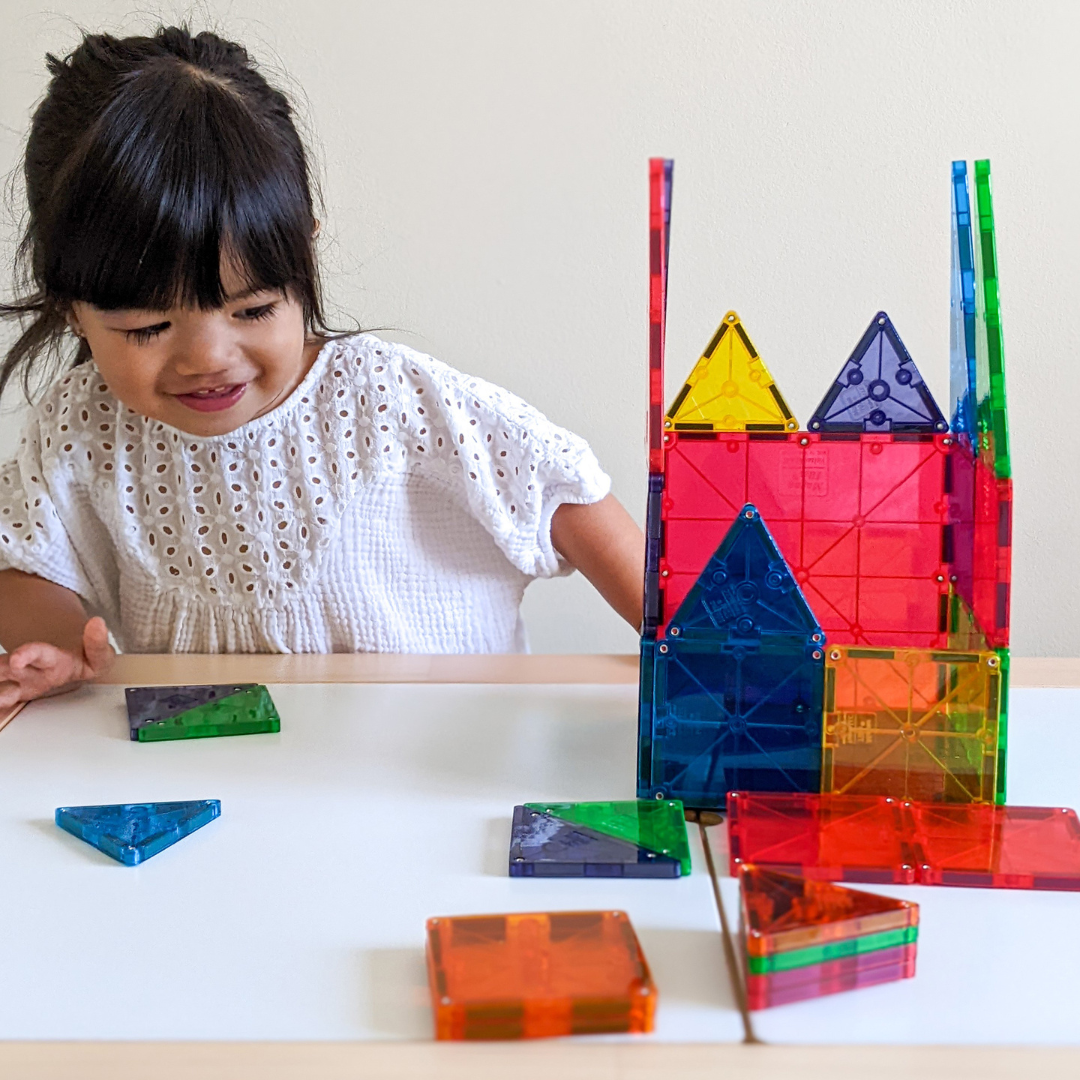

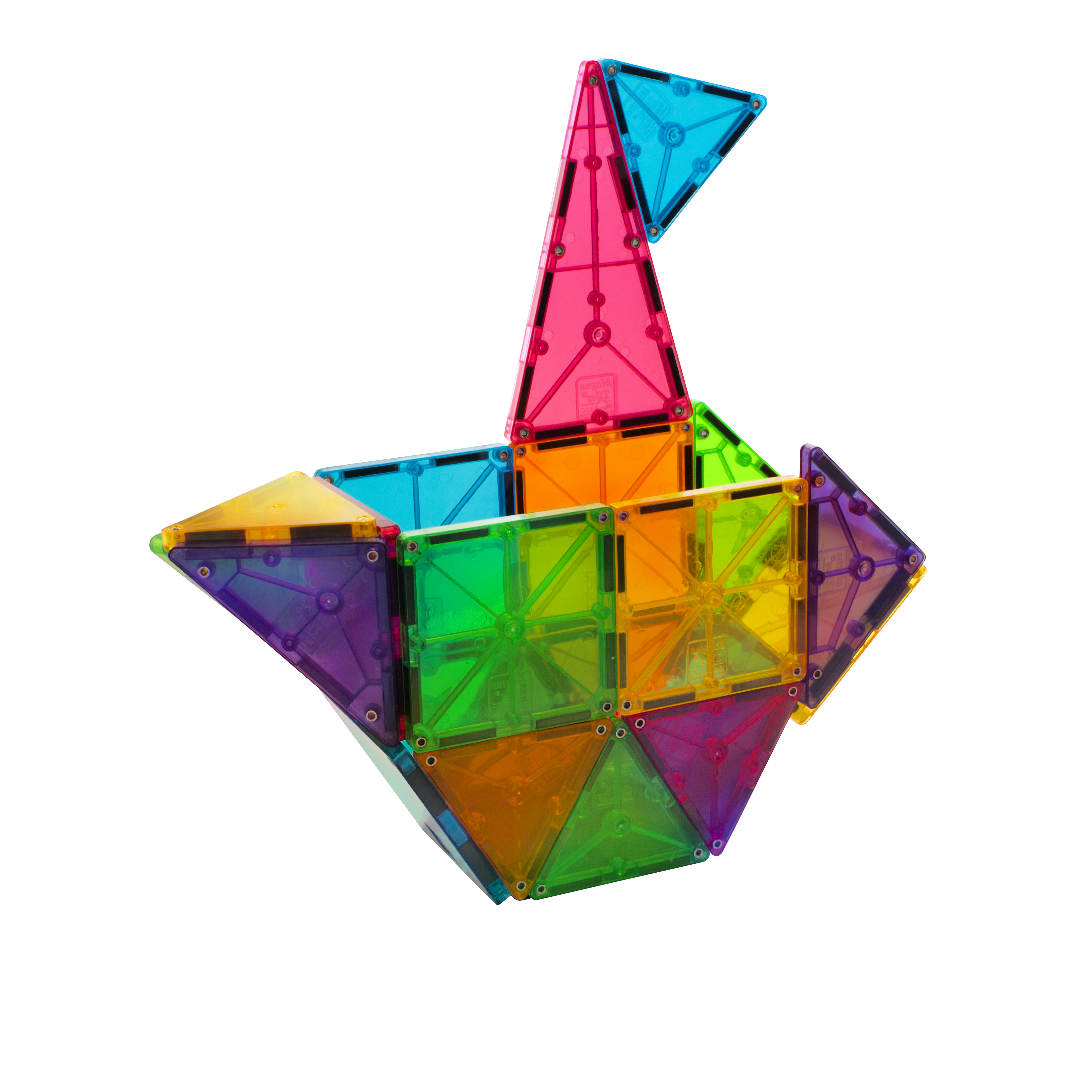
Magna-Tiles are flat, colorful plastic tiles with magnets along the edges that snap together to form 2D patterns and 3D structures. There are no instructions, no app, and no scripted outcome -- kids just grab tiles and build whatever they want, from simple houses to tall towers to elaborate castles. The magnets are strong enough to hold but weak enough that a toddler can pull pieces apart, and collapsed structures rebuild in seconds.
Magna-Tiles has focused developmental strength worth knowing about. It builds agency, creativity. The main growth opportunity: Magna-Tiles do not build persistence the way a harder system does.
Strengths & gaps
Strengths
- ● Magna-Tiles are strongest for Agency and Creativity. The toy gives children a blank canvas and leaves the goal, shape, and ending in their hands.
- ● Magna-Tiles also create real spatial thinking practice. Children have to make roofs hold, towers stand, and shapes fit, which pushes problem-solving without turning the toy into a drill.
- ● Magna-Tiles work well in families and classrooms. The learning hub's sibling and teacher reports match what parents see at home: this is easy to share and easy to talk through.
Gaps
- ○ Magna-Tiles do not build persistence the way a harder system does. The pieces snap together fast, and a collapse is easy to fix.
- ○ Curiosity is real but shallow. Kids discover magnet behavior and structure, but the toy does not open onto hidden systems or long rabbit holes.
- ○ Judgment and Purpose stay outside scope at this age. The toy is doing the right developmental job for preschool and early elementary children, which is mostly hands-on building and play.
Detailed scores
How Magna-Tiles performs on each of the 9 literacies in our framework.
Doing
— 1 of 3 Strong
Magna-Tiles give the child the whole problem. There is no instruction manual or preset outcome, so the child decides whether to build a castle, a rocket, or something with no name yet. That is self-directed goal setting, not just choosing from a list. The child also owns the result. If the build falls apart, they decide what to change and when to stop. That is exactly the kind of ownership the rubric treats as Strong.
Magna-Tiles create frustration when a structure collapses, and that is real practice. Children have to rebuild, re-balance, and try again. The learning hub's report of 45-minute engagement suggests some sustained attention, too. But the toy stays easy to reset. The pieces snap together quickly, so the child never has to sit inside difficulty for long. That keeps the rating at Moderate.
Magna-Tiles ask children to change shape, angle, or support when a build fails. A roof that will not stay up usually needs a different triangle or a different base. The Zhang study on block-building complexity fits this kind of spatial adjustment. The problem is that the child is still in one building mode. They are adapting within construction, not switching into a genuinely different kind of task. That is enough for Moderate, not Strong.
Thinking
— 1 of 3 Strong
Magna-Tiles invite questions. Why do some sides stick and others repel? Why does a flat stack become a 3D shape? The official and parent sources all point to this kind of early spatial wondering. But the toy does not keep opening new questions. Once a child figures out the basics, the play stays in a familiar loop. That is good curiosity support, just not strong enough to go further.
Magna-Tiles are a blank canvas with useful constraints. The child starts with shapes and magnets, then makes something original. There are no templates and no right answer. The play also naturally supports revision. A tower can become a castle, then a house, then a different castle after it falls. That combination of invention and revision is Strong creativity.
Magna-Tiles are built for ages 3-8, and broader evidence-based judgment usually develops later. The child does make simple choices here, but they are mostly about shape and stability. That is not the kind of evaluative reasoning this rubric is trying to score. Not Assessed is the right age-normalized call.
Being
— 0 of 3 Strong
Magna-Tiles make co-play easy. The learning hub reports sibling play, The Everymom describes parents joining in, and teachers use them in group settings. The toy sits in the middle of the table and invites talk. Still, the toy does not require other people. A child can play alone for a long time. That makes Connection real but context-dependent.
Magna-Tiles create low-stakes frustration. A tower falls, a child sighs, and then the child has to decide whether to rebuild or walk away. That is useful regulation practice. But the toy does not teach calming strategies or label emotions. Kids who already have some frustration tolerance will use it here. That keeps the rating at Moderate.
Purpose is not the main job of Magna-Tiles for this age range. Children are building because building feels good, and that is enough at 3-8. The corpus does not show identity work, values work, or contribution beyond the play itself. Not Assessed is the correct label.
Based on 9 sources
- Product pubmed.ncbi.nlm.nih.gov —
- Product magnatiles.com — faq
- Product magnatiles.com — learning
- Product magnatiles.com — magna tiles difference
- Product magnatiles.com — for new builders
- Product theeverymom.com — magnatiles review
- Product goodhousekeeping.com — magna tiles amazon prime day deals oct
- Product kidzinc.com.au — magna tiles benefits ages why parents and educators love them
- Product researchparent.com — magna tiles
Reviewed by New Literacies
Scored by our research-derived framework · AI-assisted analysis with editorial review · 9 sources reviewed · Our methodology →
Get the next guide before it goes live
One email when a new product review ships.
Free. No spam. Unsubscribe anytime.
See other products strong in the same literacies: