Little Pim
Ages 0-6 · freemium · Product · littlepim.com ↗
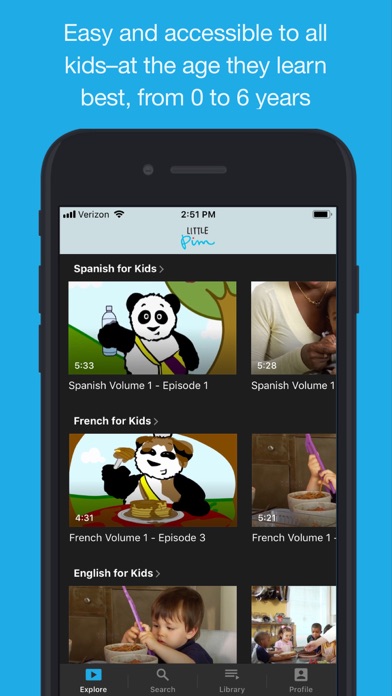
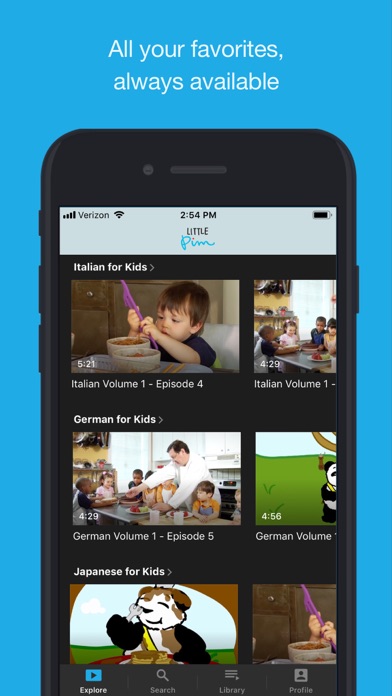
Little Pim is a video subscription service that teaches babies and toddlers vocabulary in 12 languages through short animated episodes. A cartoon panda named Pim introduces words in five-minute videos covering themes like eating, playtime, and feelings. Kids hear each word spoken by a native speaker, see it illustrated, and then complete two simple matching activities. The product includes printable parent guides and weekly lesson scripts so parents can reinforce vocabulary offline.
We've reviewed Little Pim against our 9-literacy developmental framework. The main growth opportunity: Little Pim is passive by design.
Strengths & gaps
Strengths
- ● Little Pim targets the early language acquisition window (ages 0-6) with native-speaker audio in 12 languages. For parents who want to expose babies to foreign language sounds, the product is well-designed for that narrow goal.
- ● Parent guides and weekly lesson scripts support offline reinforcement. This is one of the few language products that actively equips parents to extend learning beyond screen time.
Gaps
- ○ Little Pim is passive by design. Babies and toddlers watch videos. The two matching activities per video are the only interactive elements, and they're minimal.
- ○ No developmental capacity reaches Moderate. Even with generous age normalization for babies, video watching doesn't exercise agency, persistence, curiosity, or creativity.
- ○ The product doesn't scaffold parent-child interaction during videos. Co-viewing may happen naturally, but Little Pim doesn't require it or guide it in real time.
Detailed scores
How Little Pim performs on each of the 9 literacies in our framework.
Doing
— 0 of 3 Strong
Little Pim's primary activity is watching five-minute videos. The child's role is receptive. Common Sense Media notes kids "see an image and hear Pim say it clearly" before selecting from pictures. Even for babies, this is passive reception, not initiation.
Five-minute videos are designed for very short attention spans. No difficulty, no struggle, no challenge. The design accommodates where children are rather than building longer focus.
Same format across all 12 languages and all themes: animated video, word presentation, matching activity. No variation in approach.
Thinking
— 0 of 3 Strong
Words are presented as complete packages. Hear the word, see the picture, see the text. No knowledge gaps are created. For babies and toddlers, the animated panda is appealing, but appeal isn't the same as curiosity.
Video watching has no creative dimension. No creation, no building, no open-ended interaction of any kind.
Being
— 0 of 3 Strong
Little Pim provides parent guides and lesson scripts, which acknowledges that very young children learn best with caregiver involvement. But the video product itself doesn't require or scaffold co-viewing. The parent resources are supplementary materials, not integrated features. Limited rather than Not Assessed because the product enters the Connection space, just weakly.
Short, pleasant, consistently positive video content. No frustration, no waiting, no emotional challenge. The product creates a calm, enjoyable experience rather than one that practices regulation.
Based on 5 sources
Reviewed by New Literacies
Scored by our research-derived framework · AI-assisted analysis with editorial review · 5 sources reviewed · Our methodology →
Get the next guide before it goes live
One email when a new product review ships.
Free. No spam. Unsubscribe anytime.