Kira Learning
Ages 5-17 · paid · AI Product · kira-learning.com ↗
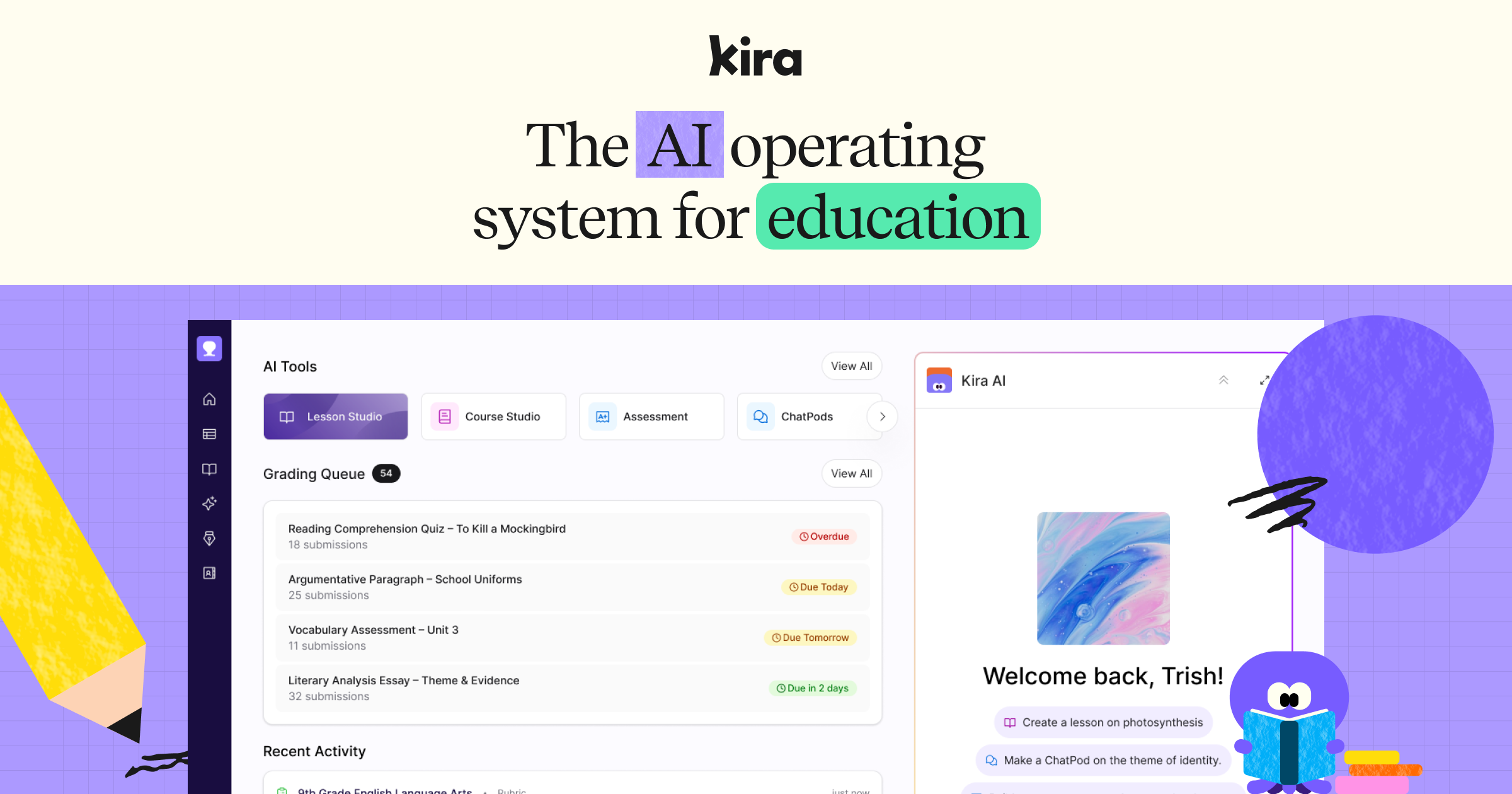

Kira Learning is a school platform that combines AI tutoring, course delivery, and teacher-facing automation in one web product. On the student side, the clearest public experience is guided tutoring plus coursework, including browser-based computer science work. In practice, the child works inside a school-set sequence while the system adapts support and tracks progress.
We've reviewed Kira Learning against our 9-literacy developmental framework. The main growth opportunity: public evidence is thin. There is not much independent reporting on what students actually do with Kira over time.
Full review
The NL Score measures developmental capacity-building, not product quality.
Strengths & gaps
Strengths
- ● Kira's best case is adaptive support inside real school coursework. Knowledge maps, tutoring, and guided feedback can help students keep moving without leaving the class workflow.
- ● The computer science roots matter. When students are actually building and revising code, Kira offers more agency and creativity than a plain answer-generator does.
Gaps
- ○ Public evidence is thin. There is not much independent reporting on what students actually do with Kira over time.
- ○ The product is still highly school-shaped. Teachers and the platform set most goals, pacing, and success conditions.
- ○ Connection and Purpose are mostly absent from the surfaced evidence.
Detailed scores
How Kira Learning performs on each of the 9 literacies in our framework.
Doing
— 0 of 3 Strong
Kira gives students some real room to act, especially in tutoring and coding tasks. But the system is still school-owned and assignment-led. The child works inside a frame more than they author the frame.
Kira's calibrated feedback and Socratic framing can keep students from stalling out immediately. But the same AI support can remove some of the friction that builds deep persistence. That leaves Persistence supported, not maximized.
This is one of Kira's clearest strengths. The platform is built around personalization, knowledge maps, and tuned support. But the child is mostly receiving adaptation rather than practicing meta-learning for themselves.
Thinking
— 0 of 3 Strong
Question-led tutoring is better for curiosity than pure answer delivery. Kira seems to aim for that kind of guided inquiry. The evidence still isn't strong enough to show deep, self-directed exploration.
Kira's coding environment gives students a place to make and revise work. That raises it above a pure teacher workflow tool. But the larger experience remains structured and school-directed.
Students likely compare explanations, inspect outputs, and decide what works. That exercises some judgment. But the AI still carries a large share of the thinking burden.
Being
— 0 of 3 Strong
The public record on Kira is about tutoring, analytics, and school integration. It does not show peer collaboration or relationship-building as a core mechanism. Connection stays outside scope.
Kira can support task focus through structure, feedback, and visible progress. That may help students stay with the work. But no explicit self-regulation teaching surfaced in the evidence.
Kira is framed around personalization and instructional efficiency. It is not framed around identity, service, or contribution. Purpose is not visible in the sourced student experience.
Based on 4 sources
Reviewed by New Literacies
Scored by our research-derived framework · AI-assisted analysis with editorial review · 4 sources reviewed · Our methodology →
Get the next guide before it goes live
One email when a new product review ships.
Free. No spam. Unsubscribe anytime.