KidsChatGPT
Ages 5-12 · freemium · AI Product · kidschatgpt.com ↗
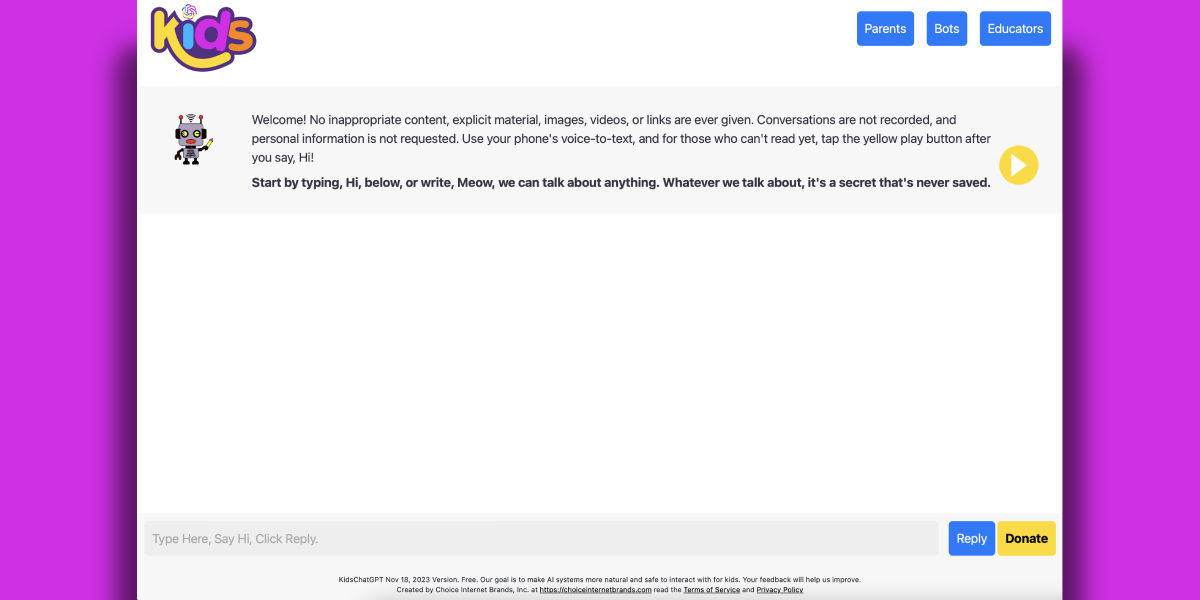
KidsChatGPT is a browser-based chatbot for children with topic bots for school, emotions, friendship, roleplay, and more. Kids can start chatting without an account, and the paid parent plan adds transcripts, summaries, and analytics. It is trying to be both safe AI chat and a general-purpose support companion.
We've reviewed KidsChatGPT against our 9-literacy developmental framework. The main growth opportunity: Judgment is weak.
Strengths & gaps
Strengths
- ● KidsChatGPT is broad. A child can move from school help to roleplay to emotional support in one place.
- ● The public access model is friction-free, which makes it easy for children to try.
- ● The free-tier timer is one small design choice that slows usage rather than maximizing speed.
Gaps
- ○ Judgment is weak. The public experience does not foreground sources, and the site’s own policy language raises trust questions.
- ○ Persistence is weak too. The chatbot gives quick help instead of requiring much independent effort.
- ○ Confidence is limited overall. Most of the evidence comes from the company’s own pages, not from outside review.
Detailed scores
How KidsChatGPT performs on each of the 9 literacies in our framework.
Doing
— 0 of 3 Strong
KidsChatGPT lets children choose what to ask and which topic bot to use. That is a real choice. But after that, the experience is fully bot-led. The child is steering the subject more than the process.
This is an instant-help product. Even with the response timer on the free tier, the basic promise is still rapid conversational support. That lowers the amount of time a child spends wrestling with a hard question independently. Persistence is a weak point.
The topic menu is broad enough to create some flexible use. A child can talk about friendship in one moment and school challenges in the next. But the method never really changes. It is still one chat pattern repeated across domains.
Thinking
— 0 of 3 Strong
KidsChatGPT can open some doors simply by being broad and easy to use. A child may ask a follow-up question they would not have asked otherwise. But the replies tend to satisfy the question quickly rather than hold the child in a deeper inquiry loop. Curiosity is present, but not strongly developed.
Roleplay adventures do give children a more imaginative space than many educational bots. But the AI is still carrying a lot of the narrative and ideation load. That keeps Creativity in the moderate range.
The product does not clearly teach children to ask where an answer came from. That matters. It matters more because the current Terms page contains mismatched finance language, which makes the trust layer look unfinished. KidsChatGPT may be useful, but it does not provide strong evidence that it builds judgment.
Being
— 0 of 3 Strong
The chatbot can simulate support, but that is not the same as building human connection. Parent plans add oversight, not shared play or collaboration. Connection is not a clear strength of the product itself.
The response timer is a small point in its favor. It adds a speed bump instead of optimizing for endless back-and-forth. Some topic bots also gesture toward emotional support. But the evidence for actual self-regulation building is limited, so Moderate is the ceiling.
KidsChatGPT does not meaningfully connect use to values, service, identity, or contribution. It is a general-purpose child chatbot.
Based on 6 sources
- Product kidschatgpt.com
- Product kidschatgpt.com — about
- Product kidschatgpt.com — pricing
- Product kidschatgpt.com — home
- Product kidschatgpt.com — educators
- Product kidschatgpt.com — tos
Reviewed by New Literacies
Scored by our research-derived framework · AI-assisted analysis with editorial review · 6 sources reviewed · Our methodology →
Get the next guide before it goes live
One email when a new product review ships.
Free. No spam. Unsubscribe anytime.