It Takes Two
Ages 10-14 · paid · Product · ea.com ↗
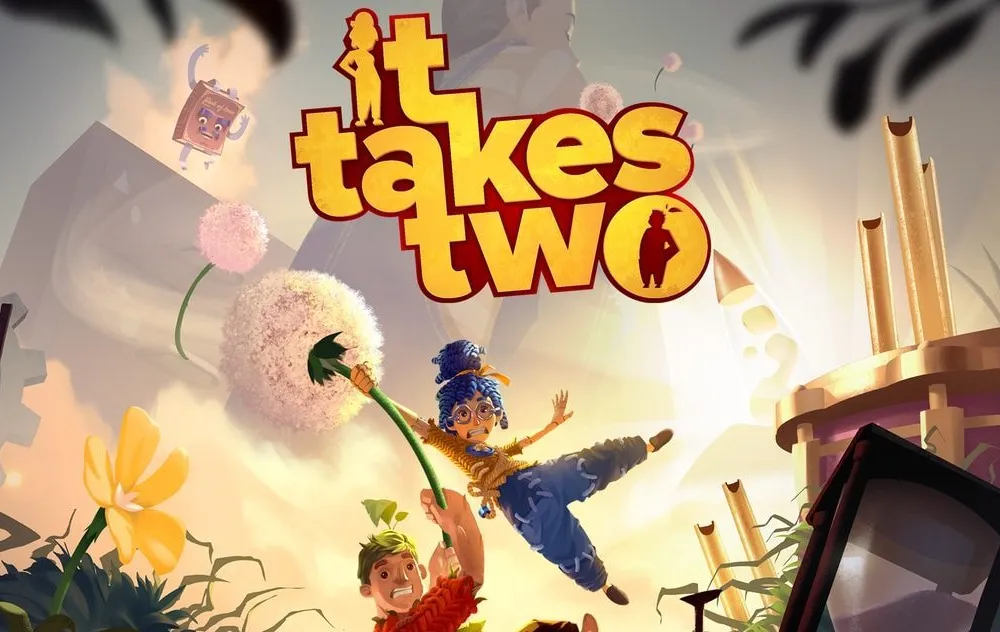
It Takes Two is a strictly two-player cooperative adventure game from Hazelight Studios that won Game of the Year, Best Family Game, and Best Multiplayer Game at The Game Awards 2021. Two players control Cody and May — a divorcing couple magically transformed into dolls by their daughter's tears — and must work together to find their way back to human form. Almost every puzzle and traversal sequence in the 12–15 hour campaign requires the two players to use different, complementary abilities at the same time: one player has a hammer, the other a nail; one fires sap, the other fires matches that ignite it; one freezes water, the other pushes it. Solo play is impossible by design. Co-op is split-screen on the same couch or online via the Friend's Pass — only one purchased copy is needed for two players to play the entire game together.
It Takes Two has focused developmental strength worth knowing about. It builds adaptability, connection. The main growth opportunity: **Creativity is not the design target.
Strengths & gaps
Strengths
- ● Connection is structurally enforced. This is the rarest property in screen-mediated play: the design cannot be played in parallel silence. One player has the hammer, the other has the nail; one player can see what's coming, the other can move through it. Talking — narrating, instructing, coordinating, apologizing — is the only way to progress. IGN's review described it as "bubbling over with creativity" and praised the way mechanics force genuine cooperation. This is the elephant-question rebuttal: a screen as the place a parent and child find each other, not lose each other.
- ● Adaptability is unusually high for a narrative game. Hazelight introduces a new mechanic, ability, or genre conceit roughly every 30–60 minutes — magnet boots, time rewinding, gravity flipping, music-rhythm sequences, top-down combat, side-scrolling, stealth. Each pair of abilities is asymmetric: the two players must rapidly figure out who has what and how the new pairing works. Switching cognitive modes alongside another person is the developmental load.
- ● One copy, two players. The Friend's Pass means a parent can buy one copy and the second player downloads a free companion app to join the entire campaign. This removes the structural objection ("$80 for two copies") that blocks most family co-op gaming.
- ● No PvP, no online strangers, no algorithmic feed. This is closed-loop cooperative play — the only other person in the experience is the person sitting next to you (or on the other end of a known invite).
Gaps
- ○ Creativity is not the design target. Solutions are prescribed; players execute, they don't invent. There is no building, drawing, writing, or open-ended generation.
- ○ Themes are genuinely mature. Divorce, marital resentment, the daughter's grief, and a particularly affecting sequence involving a stuffed elephant are handled with real emotional weight. Common Sense Media rates the game 14+ (more conservative than the ESRB T or PEGI 12 ratings) and flags concerns about disturbing scenes and dialogue. This is not a "hand the kid the controller" product.
- ○ Purpose / values dimension is shallow. The reconciliation arc is delivered through cutscene rather than player choice. The game says cooperation matters; it doesn't ask the player to figure out why.
- ○ Two-player ONLY. Cannot play solo. Cannot play three or four. A family of three with one kid works; a family of three with two kids forces a rotation.
This product has been scored but not yet fully reviewed. Detailed literacy rationales will be added in a future update.
Based on 6 sources
- Review commonsensemedia.org — it takes two
- Product en.wikipedia.org — The_Game_Awards_
- Product en.wikipedia.org — It_Takes_Two_(video_game
- Product esrb.org — it takes two
- Product ea.com — itt friends pass
- Product gamespot.com — 1100
Reviewed by New Literacies
Scored by our research-derived framework · AI-assisted analysis with editorial review · 6 sources reviewed · Our methodology →
Get the next guide before it goes live
One email when a new product review ships.
Free. No spam. Unsubscribe anytime.
See other products strong in the same literacies: