
Gravity Maze
Ages 8-14 · paid · Product · thinkfun.com ↗
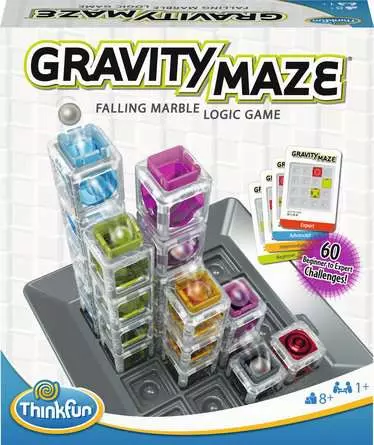
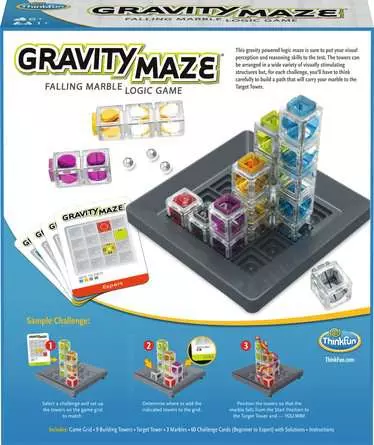
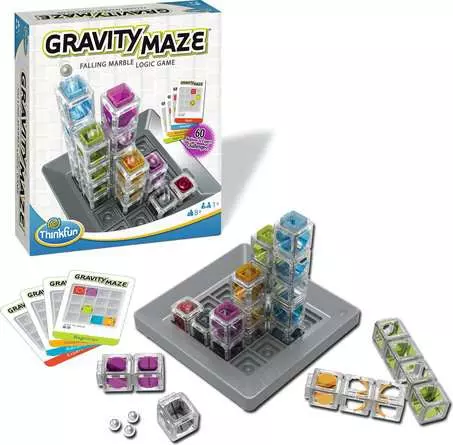
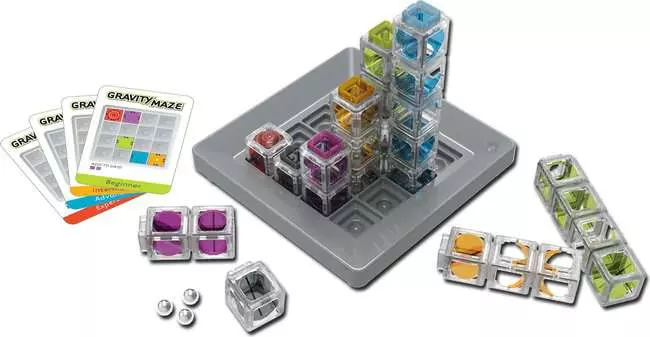
Gravity Maze is a single-player marble-run logic game where kids build a 3D tower path on a grid so a marble reaches the target. They work through 60 challenge cards from beginner to expert, then test the maze immediately and rebuild when the route fails. ThinkFun sells it as a physical STEM puzzle for kids who like challenging problems.
Gravity Maze has focused developmental strength worth knowing about. It builds persistence, judgment. The main growth opportunity: It is still a prescribed puzzle, not open-ended play.
Strengths & gaps
Strengths
- ● Gravity Maze is strongest for Persistence and Judgment. Kids keep rebuilding until the maze works, and every placement matters.
- ● The physical build makes the thinking visible. You can see the path, test it, and learn from the result immediately.
- ● Some kids go beyond the cards and invent their own mazes. That gives the puzzle a useful self-directed edge.
Gaps
- ○ It is still a prescribed puzzle, not open-ended play. The child mostly solves cards rather than setting the whole direction.
- ○ Connection is thin. Families can play around it, but the game itself is single-player.
- ○ Purpose stays outside the design. The STEM framing is useful, but it doesn’t connect to values or contribution.
Detailed scores
How Gravity Maze performs on each of the 9 literacies in our framework.
Doing
— 1 of 3 Strong
Gravity Maze gives kids meaningful control over how they solve each challenge. They decide where each tower goes, test the result, and often rebuild after the marble fails. The Board Game Family also shows kids inventing their own mazes and challenging other people to solve them. But the goal is still set by the card, so the agency is real but bounded.
Gravity Maze asks for repeated effort in a way that feels legitimate, not decorative. The official page promises 60 challenges from beginner to expert, and multiple reviews describe trial and error, stuck moments, and the relief of finally landing the marble in the target. ThinkFun also includes solutions in the box, which lets kids recover and keep going instead of getting stranded. That is classic productive struggle.
Gravity Maze forces kids to revise their plan when the marble misses the target. The child has to notice what didn’t work, shift the tower layout, and try a different route. That is real adaptation, but it happens inside one fixed marble-run system. The child is changing strategy, not switching among different kinds of problem.
Thinking
— 1 of 3 Strong
The game naturally pulls kids toward questions about gravity, cause and effect, and why a route works or fails. Screenwise frames it as a physics-and-planning puzzle, and Learn Richly notes that the challenge gets more interesting as the spatial layout becomes harder to read. But the curiosity loop is narrow. The puzzle answers itself once the marble lands.
Gravity Maze does let kids create. The Board Game Family says their child loved inventing endless maze configurations and using the pieces to challenge others. But the core product is still a prescribed challenge deck with a single correct solution per card. That keeps the creative room real, but not wide open.
Judgment is central here. Every tower placement changes the marble’s path, so kids have to weigh options before committing to a build. Board Game Authority and Learn Richly both describe the game as a logic puzzle with a single solution, which makes the decision-making concrete and visible. This is not guesswork. It is repeated evaluation under immediate feedback.
Being
— 0 of 3 Strong
Gravity Maze is a solo logic game by design. Families can play with it together, and some reviewers do use it as a shared challenge, but that comes from the context around the box rather than the product itself. The game does not require conversation, teamwork, or belonging. Connection stays outside the scored scope.
The game creates frustration, then gives kids a way through it. ThinkFun says solutions are included in the packaging, and reviewers describe kids staying with the challenge long enough to recover after failed attempts. That supports emotional recovery. But Gravity Maze does not teach calming routines or self-talk, so the regulation practice is implicit rather than explicit.
Gravity Maze has a STEM frame, but that is not the same as purpose. The product teaches spatial thinking and problem solving without connecting effort to values, service, or identity. That makes Purpose too thin to score cleanly here.
Based on 8 sources
- Product thinkfun.com — gravity maze
- Product goodplayguide.com — gravity maze
- Product boardgameauthority.com — gravity maze game review
- Product learnrichly.com — review gravity maze thinkfun
- Product screenwiseapp.com — gravity maze boardgame
- Product theboardgamefamily.com — gravity maze puzzle game review
- Product theparentspot.com — quality and so much fun with thinkfun gravity maze and robot turtles
- Product thinkfun.com — thinkfun
Reviewed by New Literacies
Scored by our research-derived framework · AI-assisted analysis with editorial review · 8 sources reviewed · Our methodology →
Personalization bridge
Not sure what your kid needs most?
Take the quiz to see which literacies matter most for your family, then get practical things to try at home.
Get your family profileExplore more
See other products strong in the same literacies: