
Funexpected Math
Ages 3-7 · freemium · Product · funexpectedapps.com ↗
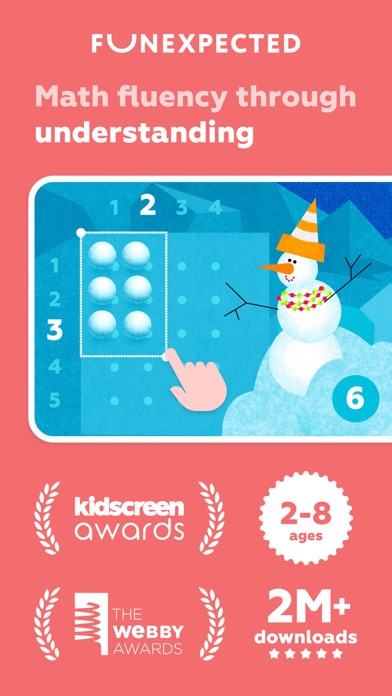
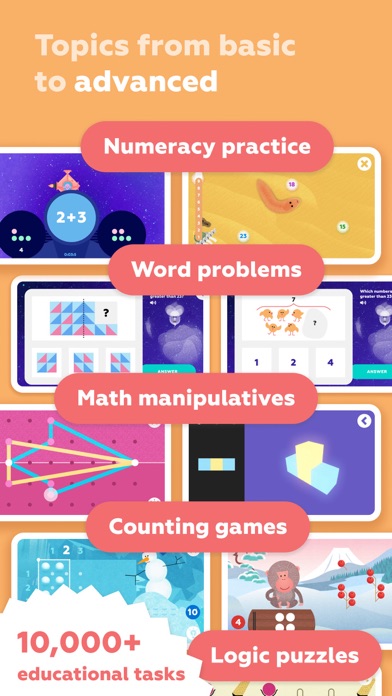
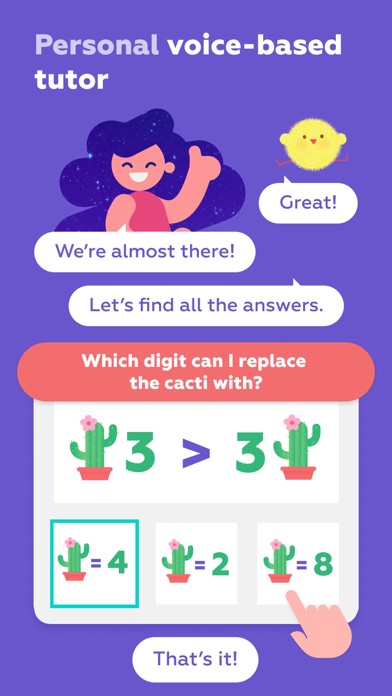
Funexpected Math is a puzzle-based early math app for ages 3-7. Kids tap into themed locations on a map, then solve short activities on counting, shapes, patterns, logic, spatial reasoning, and early coding concepts. A built-in tutor adjusts difficulty and offers hints when they get stuck.
We've reviewed Funexpected Math against our 9-literacy developmental framework. The main growth opportunity: Funexpected Math doesn't clear the Recommended bar because nothing in the current evidence reaches Strong.
Strengths & gaps
Strengths
- ● Funexpected Math's biggest strength is breadth. Common Sense and educator reviews both point to geometry, logic, algorithms, and spatial reasoning on top of the usual counting-and-shapes work.
- ● Funexpected Math keeps young children engaged with strong presentation and varied task types. That matters in early math, where too many apps collapse into repetitive tapping.
- ● Funexpected Math gives teachers and parents useful oversight. Adults can preview games, inspect covered concepts, and review progress without interrupting the child-facing flow.
Gaps
- ○ Funexpected Math doesn't clear the Recommended bar because nothing in the current evidence reaches Strong. The app looks broad and polished, but the developmental depth is still modest.
- ○ Agency stays low. The child works through a guided sequence of puzzles rather than setting goals, choosing a path, or building something original.
- ○ Self-Regulation is also narrow. The app is designed to keep frustration low, which helps usability but gives children less practice managing difficulty on their own.
Detailed scores
How Funexpected Math performs on each of the 9 literacies in our framework.
Doing
— 0 of 3 Strong
Funexpected Math gives the child bounded choice, not real control. Kids can pick a place on the map, but the app determines the learning path, puzzle structure, and success conditions. Common Sense reviews also note that adults, not children, get the main visibility into progress and settings. That keeps Agency in Limited.
Funexpected Math can hold a child's effort longer than a basic drill app. Reviewers describe sustained engagement, and the progression clearly ramps challenge over time. But the app still cushions the hard parts with hints, guidance, and short-session design. It builds some persistence, not the kind of productive struggle that earns Strong.
Funexpected Math does a good job moving children between different kinds of mathematical thinking. Counting, geometry, logic, algorithms, and spatial tasks ask for different responses, and that variety is real. But children are still adapting inside a tightly designed system. They are not choosing strategies in an open-ended environment or reflecting on how their thinking changes.
Thinking
— 0 of 3 Strong
Funexpected Math introduces genuinely surprising ideas for early learners. Algorithms, quadrilaterals, and logic puzzles are not standard preschool-app fare, and that novelty matters. But curiosity here is mostly sparked by the app's content choices, not by child-led inquiry. The product opens doors, then keeps the child on its own rails.
Funexpected Math presents math creatively, but it does not ask the child to be especially creative. The child manipulates objects and explores clever visual puzzles, yet each activity still aims at a target answer. There is no blank canvas, no artifact creation, and no open-ended mathematical invention.
Judgment is outside the meaningful scope of this product. Funexpected Math focuses on early-childhood puzzle solving with fixed answers. It does not ask children to weigh evidence, compare perspectives, or make evaluative decisions in the way the rubric means by Judgment.
Being
— 0 of 3 Strong
Funexpected Math is a solo app. Teachers may use it in stations and parents may sit nearby, but those relationships come from context rather than product design. The app itself does not create collaboration, belonging, or shared problem-solving.
Funexpected Math helps children stay regulated by keeping the experience smooth. That is good product design. It is not the same as building Self-Regulation. The app reduces friction through hints, pacing, and gentle support, but it does not do much to help children notice, manage, and recover from frustration on their own.
Funexpected Math is about early math confidence and fluency. It does not connect the work to identity, contribution, or values. Purpose is outside the design.
Based on 8 sources
- Review commonsensemedia.org — funexpected math
- Review commonsense.org — funexpected math
- Product edtechimpact.com — funexpected math
- Product edtechimpact.com — Y3VzdG9tZXJTdXJ2ZXlSZXNwb25zZV9mdW5leHBlY3RlZC1tYXRoX2VyaWNfMjAyNC0xMS0yMlQxODo0NToxMVo%3D
- Product apps.apple.com — id
- Product play.google.com — details
- Product funexpectedapps.com
- Product welcome.funexpectedapps.com
Reviewed by New Literacies
Scored by our research-derived framework · AI-assisted analysis with editorial review · 8 sources reviewed · Our methodology →
Get the next guide before it goes live
One email when a new product review ships.
Free. No spam. Unsubscribe anytime.