D&D Young Adventurer's Collection
Ages 8-14 · paid · Product · dndbeyond.com ↗
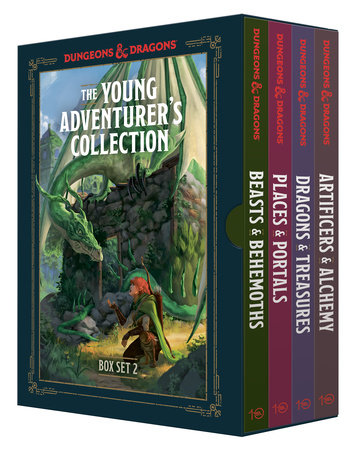
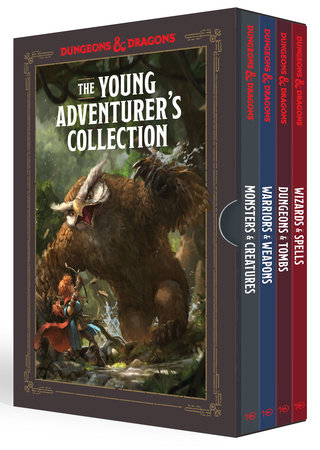
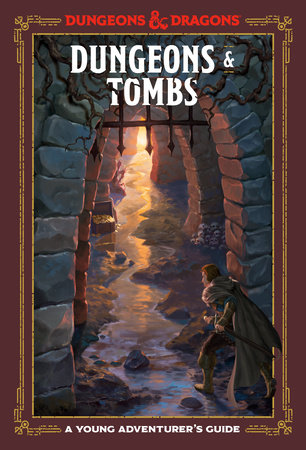
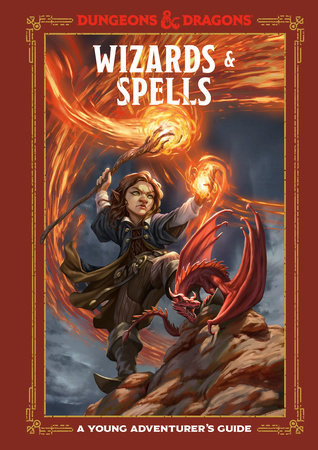
D&D Young Adventurer's Collection is a pair of 4-book boxed sets from Ten Speed Press. Kids read illustrated guides about monsters, weapons, dungeons, dragons, and magic, then use that material to invent characters, stories, and dungeon maps. The books are meant for young readers and new players, and the publisher prices each boxed set at $34.99.
D&D Young Adventurer's Collection has focused developmental strength worth knowing about. It builds creativity. The main growth opportunity: it is a springboard, not a full game system. The books do not teach actual rules in depth.
Full review
Capacity Signature
[M][N][N][M][S][M][M][N][N] -- 1 Strong, 4 Moderate, 4 Not Assessed
Legend: S = Strong, M = Moderate, N = Not Assessed
Strengths & gaps
Strengths
- ● Creativity is the clearest win. The collection is built to push kids toward their own characters, stories, and maps.
- ● It works well as a shared entry point. Reviewers describe it as collaborative storytelling and a bonding experience between adult and child.
- ● The art and bite-sized lore make fantasy feel approachable instead of intimidating.
Gaps
- ○ It is a springboard, not a full game system. The books do not teach actual rules in depth.
- ○ Persistence, adaptability, and self-regulation are not central to the design.
- ○ Purpose is outside the scope. The books invite play, not reflection on values or contribution.
Detailed scores
How D&D Young Adventurer's Collection performs on each of the 9 literacies in our framework.
Doing
— 0 of 3 Strong
D&D Young Adventurer's Collection gives kids real choices in how they imagine a character, what gear fits that character, and whether they use the books solo or with friends. The publisher frames the books as tools for creating their own D&D tales, not as a scripted sequence with one right answer. But the books do not run an actual game loop, so the agency is meaningful but bounded.
These books are built to be approachable, not demanding. Bonus Action says kids can read them on their own or with an adult, which lowers the friction instead of building a try-fail-try-again cycle. There is no repeated challenge or recovery loop inside the product itself.
The guides cover many fantasy topics, but they do not ask the child to switch strategies inside a system or revise plans after feedback. The D&D Beyond article uses the books as a starting point for a separate Simple D&D homebrew, which means the adaptation happens outside the collection. On their own, the books are reference material, not an adaptive practice system.
Thinking
— 1 of 3 Strong
The books are packed with monsters, places, magic items, and weird creatures, which naturally make kids ask what something is and how it works. Reviewers describe children getting excited about the artwork and asking questions about dragons and other creatures. That said, the content is curated and finite, so it sparks curiosity more than it sustains open-ended inquiry.
This is the collection's clearest developmental win. The publisher says the books are useful for creating your own epic D&D tales, and the writers say the series is meant to spark imaginations and encourage children to tell their own stories and play their own games. One parent said the mapmaking section pushed both kids to start drawing their own dungeon maps.
Kids have to decide what kind of hero to imagine, what equipment fits that hero, and what to do when a monster appears on the page. The books also include tips on what to do and what not to do when encountering creatures, which asks for practical judgment. But that judgment stays inside a fantasy primer, not a broader evidence or tradeoff context.
Being
— 0 of 3 Strong
The collection is built for shared use, and reviewers describe it as collaborative storytelling and a bonding experience between adult and child. The publisher also frames it as something you can use on your own or take up with friends. It supports connection, but the books themselves do not create the back-and-forth of an actual game table.
The collection does not teach calm-down strategies, waiting, or emotional recovery. Any regulation comes from the reading or play context around the books, not from the books themselves. That makes this a weak fit for scoring self-regulation directly.
The guides are about fantasy play, not identity, values, or contribution. They help a child imagine a hero, but they do not connect effort to a larger purpose. That is outside the product's design.
Based on 7 sources
- Product dndbeyond.com — 554 play d d with kids using the young adventurers
- Product tabletopjoab.com — young adventurers collection review
- Product bonus-action.com — the young adventurers collection set 2 review
- Product reddit.com — young_adventurers_collection_and_dd_annual_
- Product reddit.com — ctk
- Product penguinrandomhouse.com — the young adventurers collection box set 1 dungeons and dragons 4 books by jim zub with stacy king and andrew wheeler official dungeons and dragons licensed
- Product penguinrandomhouse.com — the young adventurers collection box set 2 dungeons and dragons 4 book boxed set by jim zub stacy king andrew wheeler official dungeons and dragons licensed
Reviewed by New Literacies
Scored by our research-derived framework · AI-assisted analysis with editorial review · 7 sources reviewed · Our methodology →
Get the next guide before it goes live
One email when a new product review ships.
Free. No spam. Unsubscribe anytime.
See other products strong in the same literacies: