
Droplets
Ages 7-16 · freemium · Product · languagedrops.com ↗
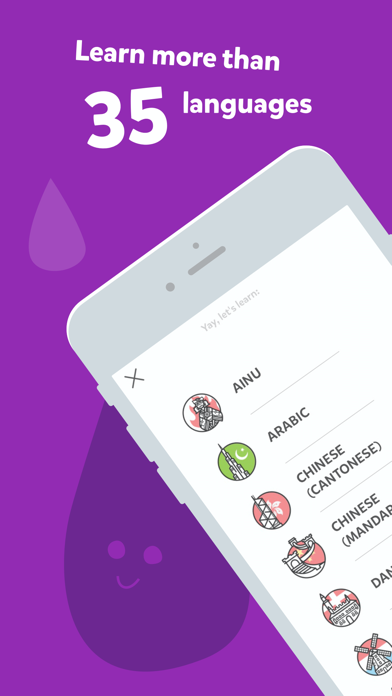
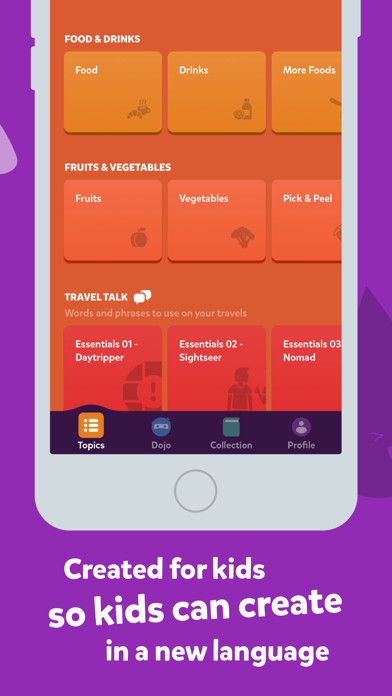
Droplets teaches vocabulary in 37 languages through five-minute daily game sessions. Kids match colorful illustrations to words by tapping, swiping, and tracing. The standout feature is alphabet drawing games where children trace unfamiliar letter forms character by character to learn new writing systems. The free version limits play to five minutes per day, which doubles as a screen-time boundary. Parents can create multiple child profiles and manage which topics are accessible.
We've reviewed Droplets against our 9-literacy developmental framework. The main growth opportunity: Droplets is vocabulary-only.
Strengths & gaps
Strengths
- ● Droplets' alphabet drawing games create genuine effort. Tracing Mandarin characters or Arabic script requires precision and practice that goes beyond tapping pictures. Kids who stick with it build real motor-learning persistence.
- ● The five-minute daily limit is a structural self-regulation feature. The app forces stopping even when the child wants more, creating a small daily practice in delayed gratification.
Gaps
- ○ Droplets is vocabulary-only. FluentU notes "you won't learn grammar, sentence structure, or conversation skills." Common Sense Media confirms it works "as a supplement rather than comprehensive language instruction." Developmentally, this limits impact across all capacities.
- ○ No creative or open-ended activities. Even the drawing games are tracing predetermined characters, not original creation.
- ○ No social dimension. Language learning without communication or collaboration.
Detailed scores
How Droplets performs on each of the 9 literacies in our framework.
Doing
— 0 of 3 Strong
Droplets prescribes all activities. Kids choose a language and topic category, but within each session the exercises are fixed: tap, swipe, trace, match. The child executes prescribed interactions, never sets goals or initiates direction.
The alphabet drawing games stand apart from typical vocabulary apps. Tracing unfamiliar letter forms requires genuine motor-skill effort and repeated practice. The five-minute daily limit creates a return-engagement pattern where mastery builds across sessions. This is modest but real persistence practice.
The same tap-swipe-trace mechanics apply across all 37 languages and all content. Whether learning Spanish food vocabulary or Japanese hiragana, the interaction pattern is identical. No adaptability is exercised.
Thinking
— 0 of 3 Strong
Droplets presents words as complete packages: illustration plus native-speaker audio. No knowledge gaps are created. No mechanism exists for exploring beyond prescribed word sets or pursuing deeper understanding of the language.
The drawing games involve tracing character forms, which is motor-skill practice, not creative expression. No open-ended creation, no original ideas, no creative risk. Every activity has one correct answer.
All exercises are binary vocabulary matching. No evaluation, no reasoning, no decisions beyond "is this the right word?" Judgment is not engaged.
Being
— 0 of 3 Strong
Droplets is a solo vocabulary app. Connection is outside its scope.
The five-minute daily timer forces a stopping point. When a child is engaged and the timer runs out, they must manage the frustration of waiting until tomorrow. This is a small but tangible self-regulation exercise that most vocabulary apps don't have. The drawing games also require patience and precision.
Vocabulary is presented as words to memorize, not as tools for communicating with real people or understanding another culture. Purpose is outside Droplets' scope.
Based on 6 sources
Reviewed by New Literacies
Scored by our research-derived framework · AI-assisted analysis with editorial review · 6 sources reviewed · Our methodology →
Get the next guide before it goes live
One email when a new product review ships.
Free. No spam. Unsubscribe anytime.