Dojo Islands
Ages 5-12 · free · AI Product · classdojo.com ↗

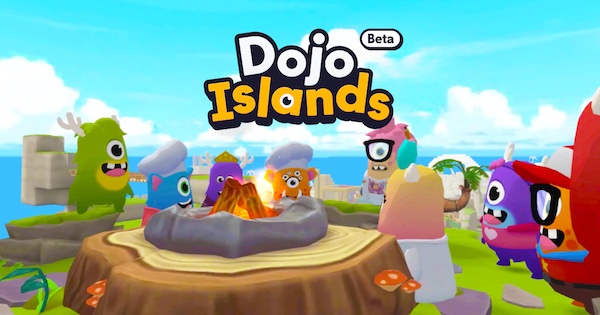


Dojo Islands is a multiplayer game where kids run around as monsters on a shared 3D island with their classmates. They explore, collect coconuts, play mini-games (tag, hide-and-seek, paint parties), and build with colored blocks in a shared Build Zone. Number Shores offers math challenges, and physics-based games like the cannon game require reasoning about trajectory and force. Kids communicate through pre-authored phrases and emoji reactions.
Dojo Islands has focused developmental strength worth knowing about. It builds agency, creativity. The main growth opportunity: Persistence, Adaptability, and Purpose are undeveloped.
Full review
Disclosure: The NL Score editor is an executive at ClassDojo and uses Dojo Islands with their children. Scored using the standard rubric and reviewed for consistency with calibration benchmarks.
Strengths & gaps
Strengths
- ● Strong for Agency at this age range. Dojo Islands gives 5-11 year olds genuine freedom to decide what to do and where to go. Challenges provide guardrails, not rails.
- ● The Build Zone is real creative sandbox work. The limited block palette (three colors plus a monthly block) and fixed grid force kids to solve creative problems within constraints. Build Challenges add structured prompts without removing open-ended invention.
- ● Safe multiplayer with known peers. Children play with classmates on a shared island, creating authentic social experiences without the risks of open platforms like Roblox.
Gaps
- ○ Persistence, Adaptability, and Purpose are undeveloped. The experience is designed to feel easy and rewarding. There's no productive struggle, no strategy-switching, and no connection between effort and values.
- ○ Social interaction is shallow. Pre-authored phrases and emoji reactions keep communication safe but prevent genuine conversation, negotiation, or perspective-taking.
- ○ Self-regulation features live in ClassDojo's broader platform, not in the game itself. Kids using Dojo Islands at home without the classroom ecosystem get less SEL exposure.
Detailed scores
How Dojo Islands performs on each of the 9 literacies in our framework.
Doing
— 1 of 3 Strong
Dojo Islands puts the child in charge of their moment-to-moment experience. At any point, a 5-11 year old can choose to build, explore, play mini-games, or join classmates. Challenges exist as optional guardrails, not mandatory paths. The Build Zone goes furthest: no prescribed outcome, no required approach, just blocks and an open canvas.
Dojo Islands is designed to feel frictionless. Daily quests are simple tasks (walk to a station, water a plant), and mini-games like tag have no difficulty curve. There's no adaptive difficulty, no growth-oriented failure framing, and no moments where a child must push through genuine frustration.
Activities follow the same patterns throughout. Collecting coconuts, building with blocks, and playing tag don't require the child to shift strategies or reflect on their approach. Number Shores adds math content across progressive levels, but this is difficulty scaling within a single format, not qualitatively different cognitive demands.
Thinking
— 1 of 3 Strong
Dojo Islands creates natural curiosity through its explorable 3D world. New areas, portals, and seasonal content give kids reasons to investigate. Sandbox building invites experimentation. But the discovery space is bounded. There are no deep rabbit holes, no mechanisms for sustained inquiry, and content is delivered rather than uncovered through investigation.
The Build Zone is where Dojo Islands earns its strongest developmental marks. Children build freely with colored blocks in a shared 3D space. The limited palette and modest build area are constraints that force creative problem-solving rather than limitations that cap it. For 5-11 year olds, this is age-appropriate creation. Build Challenges add structured prompts ("Dream School") without removing open-ended invention.
Dojo Islands includes STEM and math activities that engage early analytical reasoning. Number Shores presents curriculum-aligned math challenges. Physics-based games like the cannon game require kids to reason about trajectory and force. These build foundational analytical skills, though in-product decisions don't involve evaluating competing information or weighing tradeoffs.
Being
— 0 of 3 Strong
Dojo Islands is built around playing with classmates. Children play together as monsters on a shared island, which creates authentic belonging with known peers. Collaborative mini-games and shared building provide real social experiences. Pre-authored chat keeps interaction safe but prevents genuine communication, negotiation, or conflict resolution.
Dojo Islands benefits from ClassDojo's broader SEL ecosystem. The "Big Ideas" video series (developed with Yale's Center for Emotional Intelligence) teaches emotion identification and calming strategies. Within the game itself, self-regulation development is incidental. If scoring Dojo Islands as a standalone home product, this would likely drop to Limited.
Effort in Dojo Islands serves cosmetic avatar customization and in-game currency. There's no connection to values, self-discovery, or contribution beyond the game. Daily quests and coconut collection exist to unlock features. The Adventure Pass adds more things to unlock without adding meaning.
Based on 10 sources
- Product classdojo.com — parents
- Product classdojo.com — teachers
- Product classdojo.fandom.com — Dojo_Islands
- Product dojoislands.fandom.com — Dojo_Islands
- Product help.classdojo.com — 25040486728973 Dojo Islands for Home FAQ
- Product classdojo.com — build challenge
- Product classdojo.com — calm corner kit
- Product sel4ca.org — classdojo launches big idea in sel
- Product fittermussel37.com — honest review of dojo islands beta version
- Product smartsocial.com — classdojo
Reviewed by New Literacies
Scored by our research-derived framework · AI-assisted analysis with editorial review · 10 sources reviewed · Our methodology →
Get the next guide before it goes live
One email when a new product review ships.
Free. No spam. Unsubscribe anytime.
See other products strong in the same literacies: