DIY.org
Ages 6-16 · freemium · Product · diy.org ↗
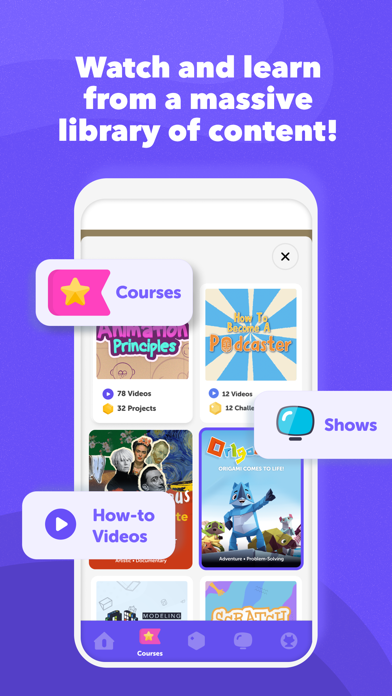
DIY.org is a project-based learning platform where kids pick from 125+ skill categories, watch short instructional videos, then build real things and upload photos or video as proof. Skills range from baking and bookbinding to coding, astronomy, and stop-motion animation. Kids earn badges by completing at least 3 challenges per skill (up to 14 per skill), and share their projects with a moderated community of other young makers.
DIY.org stands out for developmental impact across multiple literacies. It builds hands-on skills, cognitive skills, purpose. The main growth opportunity: Doesn't build Judgment.
Strengths & gaps
Strengths
- ● Strong for Curiosity and Agency through its browsable skill library. A kid who came for Minecraft builds might stumble into entomology or bookbinding, and the platform lets them follow that thread on their own terms.
- ● Builds Persistence through a well-calibrated badge structure. The "minimum 3 of 7-14 challenges" design is low enough to prevent frustration but deep enough to reward sustained effort across sessions.
- ● Supports Creativity by centering original production. Challenges give structured prompts ("build something from cardboard") with open-ended execution, and badges are earned for completion regardless of quality, which removes a key creativity barrier for kids.
- ● Builds Purpose through identity exploration. The breadth of skill categories combined with a maker community and portfolio system helps kids discover what they care about. One app store reviewer wrote: "now that's a huge part of my life."
Gaps
- ○ Doesn't build Judgment. The core loop is "watch, make, upload," with no evaluation of information quality, no tradeoff decisions, and no consequence differentiation. This isn't a flaw; it's just outside DIY.org's design scope.
- ○ Connection is real but shallow. Kids comment on each other's projects and share work, but interaction is asynchronous and moderated for safety. There's no deep collaboration, negotiation, or conflict resolution.
Detailed scores
How DIY.org performs on each of the 9 literacies in our framework.
Doing
— 2 of 3 Strong
DIY.org gives the child full control over what to learn, when to learn it, and how to demonstrate it. Kids choose from 125+ skill categories and self-select which challenges to tackle within each. The Berkman Klein/Harvard case study describes a connected learning framework that is "interest-driven, peer-supported, and production-centered." The completion-based badge system reinforces this: badges reward any genuine attempt, so the child's choices drive the experience rather than performance pressure.
DIY.org's multi-challenge badge structure creates natural sustained engagement arcs. Each skill requires completing at least 3 of 7-14 challenges to earn a badge, calibrated to be approachable but effortful. The hands-on nature of projects means struggle is built in. A duct tape wallet that falls apart or a pond that won't hold water requires real problem-solving across multiple sessions.
DIY.org exposes kids to diverse domains. A kid can move from coding to cooking to astronomy, which builds cross-domain flexibility. But within any given skill, challenges follow the same pattern: watch a video, make the thing, upload evidence. Kids can succeed with the same approach across all 125+ categories. True adaptability, recognizing when your strategy isn't working and switching tactics, isn't structurally required.
Thinking
— 2 of 3 Strong
DIY.org's browsable skill library is one of the strongest curiosity-building designs in the database. Seeing other kids' projects across 150+ topics creates "I want to try that" moments. The Homeschool Hideout parent notes kids "learn hands-on skills they may never be interested in otherwise." There are no algorithmic filters narrowing what kids see. The full range of possibilities is always visible, and kids follow tangents freely.
DIY.org is fundamentally a creation platform. Kids make original things, document them, and share them with peers. The completion-based badge system ("no matter how 'well' the task is completed," per Zift) removes fear of failure, which research identifies as a key creativity killer in middle childhood. Challenge prompts provide "freedom within limits": structured enough to start, open enough to make something your own.
DIY.org doesn't engage judgment-building mechanisms. Instructional videos present information as authoritative, challenges are "do this thing" rather than "evaluate and choose," and badges reward completion regardless of quality. Kids make practical decisions about which projects to pursue and how to approach them, but the platform doesn't require evaluating information, weighing tradeoffs, or distinguishing reliable from unreliable sources. This is outside DIY.org's design scope, not a product flaw.
Being
— 1 of 3 Strong
DIY.org's peer community is genuine and safe. Kids comment on projects, share work, and draw inspiration from each other. One reviewer wrote: "Safe place to make mistakes... the post and comment on people's post it's just amazing." But the interaction is asynchronous and structured. There's no real-time collaboration, negotiation, or conflict resolution. Connection here is more parallel (sharing projects side-by-side) than interactive (building together).
DIY.org resists the instant-gratification patterns common in kids' apps. Zift explicitly contrasts it with platforms built around "instant validation," noting it prioritizes "practical experimentation." Badge rewards come after sustained effort, not instantly. Hands-on projects inherently create moments of frustration that require patience. But self-regulation is a side effect of the maker experience, not an intentional design goal. DIY.org doesn't teach coping strategies or explicitly support emotional processing.
DIY.org's design is built around identity exploration. Browsing 125+ skill categories and trying different challenges helps kids discover what they enjoy and what they're good at. The portfolio function connects effort to future identity. Getting Smart notes these portfolios "serve excellent resources for students writing applications to high school, college or internship programs." One user's review captures this directly: "Seeing other kids' art inspired me to draw more, and now that's a huge part of my life."
Based on 11 sources
- Review commonsensemedia.org — diyorg creative challenges
- Product medium.com — building a safe digital space for young makers and learners the case of diy org 7c7457b603e
- Product gettingsmart.com — get skills awesome bring diy org students
- Product wezift.com — diy app creative community for kids
- Product josek.net — diy gamification makers
- Product homeschoolhideout.com — homeschool free using diy org
- Product justuseapp.com — reviews
- Product apps.apple.com — id
- Product diy.org
- Product diy.org — acquired by astrosafe
- Product en.wikipedia.org — DIY.org
Reviewed by New Literacies
Scored by our research-derived framework · AI-assisted analysis with editorial review · 11 sources reviewed · Our methodology →
Get the next guide before it goes live
One email when a new product review ships.
Free. No spam. Unsubscribe anytime.
See other products strong in the same literacies: