Board (board.fun)
Ages 7-12 · paid · Product · board.fun ↗
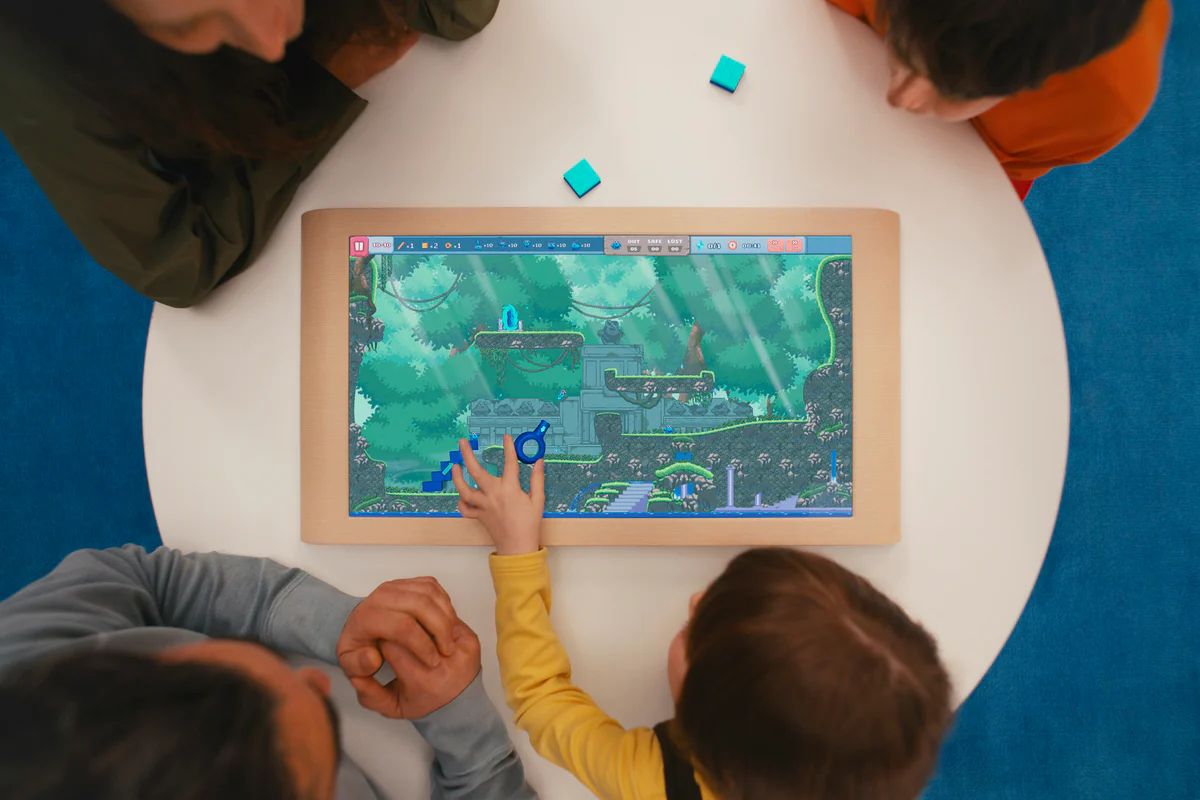
Board is a 24-inch capacitive touchscreen built into a slab that lies flat on a table — "about as much as a flatscreen TV of the same size" in weight (Wargamer). Instead of controllers, it uses physical "grabbable" components — meeples, dice, ships, robots, food tokens — whose undersides carry small conductive glyphs the screen detects and tracks in real time. You move the piece like you would in a traditional board game; the screen recognises which piece is which and animates the consequence. Reviewers consistently describe it as feeling closer to a tabletop game than a video game: players sit around the device facing each other, not a TV, and pass pieces hand-to-hand. The launch library bundled with the device is 7 games (Chop Chop, Board Arcade, Cosmic Crush, Snek, Astrofort, Starfire, Space Rocks), with another ~5 already on sale separately and "10+ new games" promised across 2026. The closest analogy reviewers reach for is "the next Wii" or "Jackbox meets a board game" — a platform whose value is co-presence and shared physical space, not graphical fidelity or competitive ranking.
Board (board.fun) has focused developmental strength worth knowing about. It builds curiosity, connection. The main growth opportunity: **Price is the single biggest barrier.
Full review
Strengths & gaps
Strengths
- ● Connection is structurally enforced, like It Takes Two but for a whole family. There are no controllers, no headsets, no second screens. To play, everyone has to sit around one flat surface, look at each other, and pass physical pieces. Wargamer's headline pro is "the most social videogame experience we've ever encountered." Meeple Mountain reports that Chop Chop in particular causes children to "spontaneously organize into a working kitchen, dividing responsibilities." This is the rarest property in screen-mediated play and the elephant-question rebuttal: the screen is the reason the family is in the same room with hands touching the same objects.
- ● Curiosity gets unusual fuel from the form factor itself. Reviewers describe a "what does this piece do?" loop that doesn't exist on a standard console — kids pick up an unfamiliar token and want to find out which game it belongs to and what happens when they place it. The 7-included + ~5-paid + monthly-new library means there's a steady drip of new mechanics to investigate, and the physical-digital seam ("how does it know?") is its own small mystery.
- ● No PvP with strangers, no algorithmic feed, no controllers. Closed-loop play with the people in the room. This is structurally important for the parents who are wary of headset-based or matchmaker-based gaming.
- ● Build quality reportedly matches the price. Meeple Mountain calls it "a revelation" and notes that "everything—everything—works" across dozens of hours of play. Wargamer awarded 8/10 and called it "sheer magic" for the right household. Newsclip was more measured at 7/10 but still positive on innovation.
Gaps
- ○ Price is the single biggest barrier. $499–$699 for hardware before any additional games are bought. This is the price of a Switch + 4 games or a PS5. Multiple reviewers explicitly flag it as the central caveat. For most families this is a "Christmas plus birthday combined" purchase, not a casual try.
- ○ The launch library is uneven. Wargamer notes "quality varies across game titles" and Newsclip's reviewer found younger players quickly identified favourites and ignored the rest. Wargamer also notes teenagers were the least engaged demographic. Anyone budgeting for "we'll get value out of all 7" should expect a working set of 3–5.
- ○ Purchased-game creep is a real medium-term risk. Only 7 titles ship with the console; another ~5 already cost $35–$45 each à la carte; 10+ new titles arrive in 2026. There is no subscription (manufacturer says so) but there is a steady upsell. A household enthusiastic about Board after 6 months should plan on $100–$200/year of additional game spend on top of the hardware.
- ○ Hardware-bound and immobile. TV-sized weight, AC-power-only, short cord. Kids can't take it to a friend's house. It lives where you put it. For parents whose kid wants to bring "the thing" to a sleepover, this is not that thing.
- ○ Single-player is weak. Multiple reviewers flag that Board is much less compelling alone. If the use case is "kid plays solo while parent makes dinner," this is the opposite of what Board is for.
- ○ Fragility concerns are real but bounded. Wargamer flags risk of lost physical components; Wargamer-launch-coverage flags vulnerability to liquid spills, overheating on carpet, and physical knocks. Meeple Mountain reports holding up well across review use; one reviewer's piece showed glyph-detection wear.
This product has been scored but not yet fully reviewed. Detailed literacy rationales will be added in a future update.
Based on 7 sources
- Product wargamer.com — games console review
- Product wargamer.com — game console
- Product meeplemountain.com — board fun device
- Product newsclip.com — unpacking the board tabletop game console a mixed bag of innovation
- Product board.fun — board console
- Product board.fun — games
- Product boardgamegeek.com — board console digital board game device
Reviewed by New Literacies
Scored by our research-derived framework · AI-assisted analysis with editorial review · 7 sources reviewed · Our methodology →
Get the next guide before it goes live
One email when a new product review ships.
Free. No spam. Unsubscribe anytime.
See other products strong in the same literacies: