
Balance Beans
Ages 5-10 · paid · Product · thinkfun.com ↗
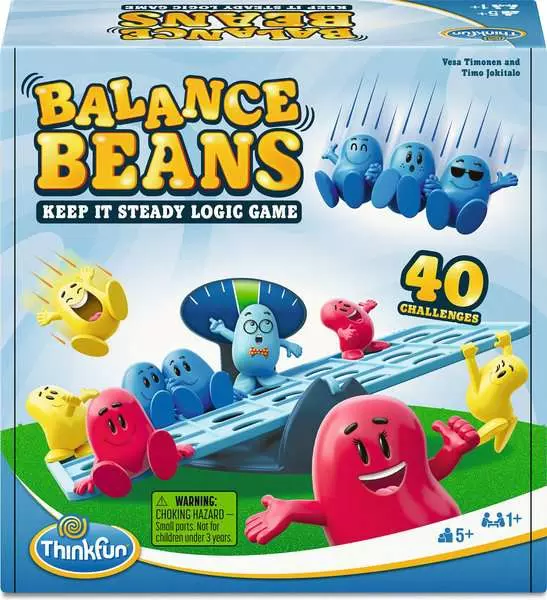
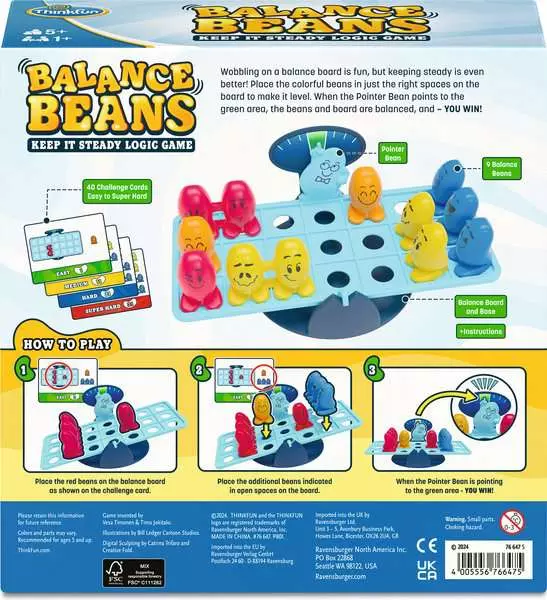
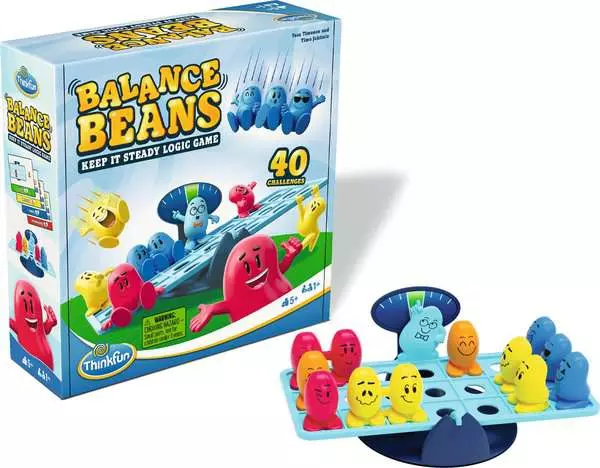
Balance Beans is a one-player logic game built around a tiny seesaw. The child sets up fixed red beans from a challenge card, then places weighted beans on the board until the whole thing balances. It feels like a toy first. But the core move is elementary algebra in physical form.
Balance Beans has focused developmental strength worth knowing about. It builds persistence, judgment. The main growth opportunity: agency is real but narrow. The child owns the move choices, not the larger direction.
Full review
The NL Score measures developmental capacity-building, not product quality.
Strengths & gaps
Strengths
- ● Balance Beans is strongest for Judgment. The child keeps making small analytical calls about weight, distance, and whether a setup is likely to work.
- ● Persistence is the other clear strength. Failed attempts are visible, fast, and easy to revise, which makes retrying feel normal.
- ● The physical board matters. It makes balancing and equality feel concrete instead of abstract.
Gaps
- ○ Agency is real but narrow. The child owns the move choices, not the larger direction.
- ○ Curiosity is present without being expansive. Balance Beans invites experimentation, but only inside a compact puzzle space.
- ○ Creativity, Connection, and Purpose are mostly outside scope. This is a sharp little logic game, not an open-ended social tool.
Detailed scores
How Balance Beans performs on each of the 9 literacies in our framework.
Doing
— 1 of 3 Strong
Balance Beans gives the child direct control over each move. They decide where to place the weighted beans and can try different approaches. But every challenge starts from a preset card and has a fixed goal. That keeps Agency at Moderate.
Balance Beans is built around retrying. A setup fails, the seesaw tips, and the child tries again with new information. Because the game gets harder over 40 challenge cards, that loop keeps asking for more effort and better reasoning. That clears Strong.
Harder puzzles force children to shift strategy instead of repeating the same move pattern. They start with trial and error, then lean more on deliberate reasoning. But all of that happens inside one stable balancing system. Moderate fits.
Thinking
— 1 of 3 Strong
The seesaw mechanic invites experimentation right away. Children naturally want to test what happens if a heavier bean moves closer to the center or farther away. That is a real curiosity signal. But the exploration space is still tight and puzzle-bound.
Balance Beans rewards clever solutions, but not open-ended creation. The child is solving designed puzzles with a small fixed set of pieces. That makes Creativity limited on this rubric.
Judgment is the core of the game. Children have to estimate, compare, and predict on every turn, then check those predictions against the board. That repeated analytical decision-making is exactly why Balance Beans works so well.
Being
— 0 of 3 Strong
Balance Beans is a one-player logic game. A parent can watch or help, but the product itself does not build collaboration or relationship skills. Connection is outside scope.
The game asks children to slow down, tolerate being wrong, and revise a failed setup without melting down. That is useful self-regulation practice. But Balance Beans does not explicitly teach those skills, so Moderate is the right ceiling.
Balance Beans is about solving a puzzle. It does not strongly connect effort to values, service, or contribution beyond the self. Purpose is outside the scored scope.
Based on 7 sources
- Product thinkfun.com — balance beans
- Product ravensburger.us — balance beans
- Product thetoyinsider.com — balance beans review
- Product sahmreviews.com — thinkfun balance beans.html
- Product ebay.com —
- Product themommiesreviews.com — thinkfun balance beans
- Product learningexpress.com — balance beans 091520.html
Reviewed by New Literacies
Scored by our research-derived framework · AI-assisted analysis with editorial review · 7 sources reviewed · Our methodology →
Personalization bridge
Not sure what your kid needs most?
Take the quiz to see which literacies matter most for your family, then get practical things to try at home.
Get your family profileExplore more
See other products strong in the same literacies: