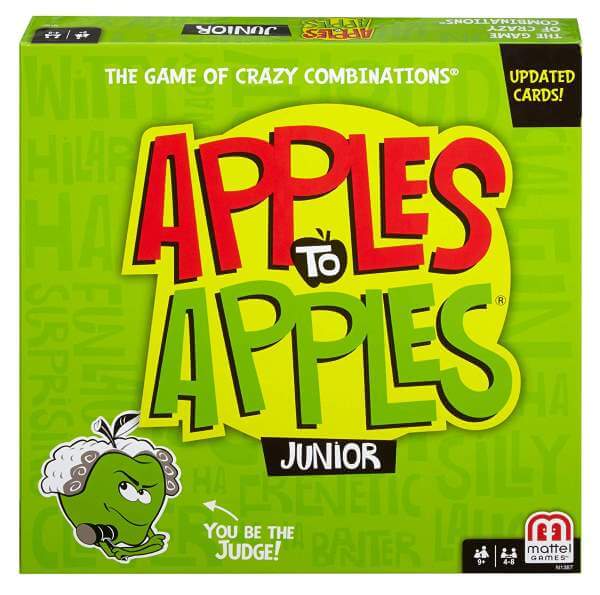
Apples to Apples Junior
Ages 9-14 · paid · Product · mattelgames.com ↗
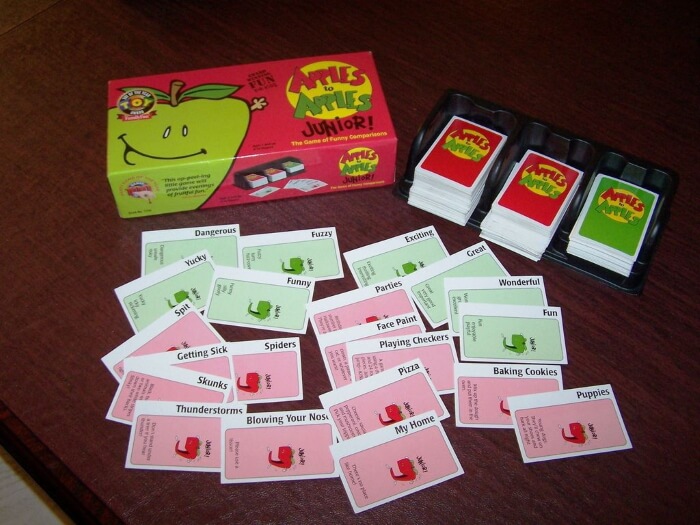
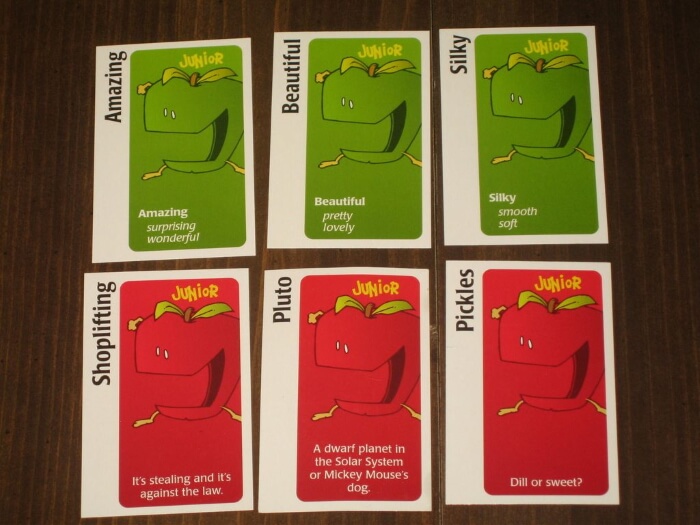
Apples to Apples Junior is a party card game where one player flips a descriptive word and everyone else chooses the funniest or smartest match from their hand. Then comes the real game: trying to persuade the judge that your answer fits. Kids are not hunting for one correct answer. They are learning how different people think.
Apples to Apples Junior stands out for developmental impact across multiple literacies. It builds adaptability, judgment, connection. The main growth opportunity: apples to Apples Junior is not a persistence builder. The rounds move too fast and the stakes stay too light.
Strengths & gaps
Strengths
- ● Apples to Apples Junior is strongest for Adaptability, Judgment, and Connection. Kids have to read a person, not just a prompt.
- ● The game teaches perspective-taking in a concrete way. A smart answer for one judge can flop completely with another.
- ● Table talk matters. Kids are not only choosing cards. They are explaining, persuading, and laughing through the choice together.
Gaps
- ○ Apples to Apples Junior is not a persistence builder. The rounds move too fast and the stakes stay too light.
- ○ Creativity is present, but bounded. Kids improvise with prewritten cards rather than building from a blank page.
- ○ Purpose is outside scope. The game is about playful social comparison, not values or contribution.
Detailed scores
How Apples to Apples Junior performs on each of the 9 literacies in our framework.
Doing
— 1 of 3 Strong
Apples to Apples Junior gives kids a meaningful choice every round. They pick the card they want to play and can argue for it in their own way. But the game still controls the hand, the prompt, and the scoring. Agency is real, but bounded.
This is not a hard game. Kids do not face long struggle, failure recovery, or deliberate practice. A missed round passes quickly and the next prompt arrives. Persistence is not central enough to score.
Good play means changing your strategy with each judge. Some judges like literal matches. Others reward the funniest or strangest answer. Kids have to notice those differences and adjust on the fly. That is a clean adaptability signal.
Thinking
— 1 of 3 Strong
The pairings are often surprising enough to make kids ask why someone chose a card. That creates small bursts of wonder and social curiosity. But the game does not support deeper exploration. The question ends when the round ends.
Creativity lives in the explanation. Kids can make an ordinary card feel brilliant by reframing it well. But they are still working from a fixed deck and a tight structure. The game supports improvisation more than original creation.
Apples to Apples Junior rewards social judgment. A child has to decide what this judge will find clever, funny, or convincing. Literal matching is often not enough. The product keeps asking the child to weigh audience, context, and consequence.
Being
— 1 of 3 Strong
The social energy is the whole point. Table talk, persuasion, disagreement, and laughter are not extras. They are the engine that makes the game work. Kids build connection by hearing how other people interpret the same prompt differently.
Because the judging is subjective, kids have to absorb unfair-feeling outcomes and move on. That gives some practice in turn-taking, emotional flexibility, and social recovery. But the stakes stay low. The game does not create deep regulation work.
Apples to Apples Junior does not connect play to identity, contribution, or values. It is a good family social game, but that is not the same thing as purpose-building.
Based on 6 sources
Reviewed by New Literacies
Scored by our research-derived framework · AI-assisted analysis with editorial review · 6 sources reviewed · Our methodology →
Get the next guide before it goes live
One email when a new product review ships.
Free. No spam. Unsubscribe anytime.
See other products strong in the same literacies: