Earlier this year, we launched Dojo Sparks at ClassDojo—an AI-powered reading coach that listens as kids sound out words and gives real-time feedback. Since then, I’ve been watching the world of AI products for kids even more closely—and testing them at home with my kids.
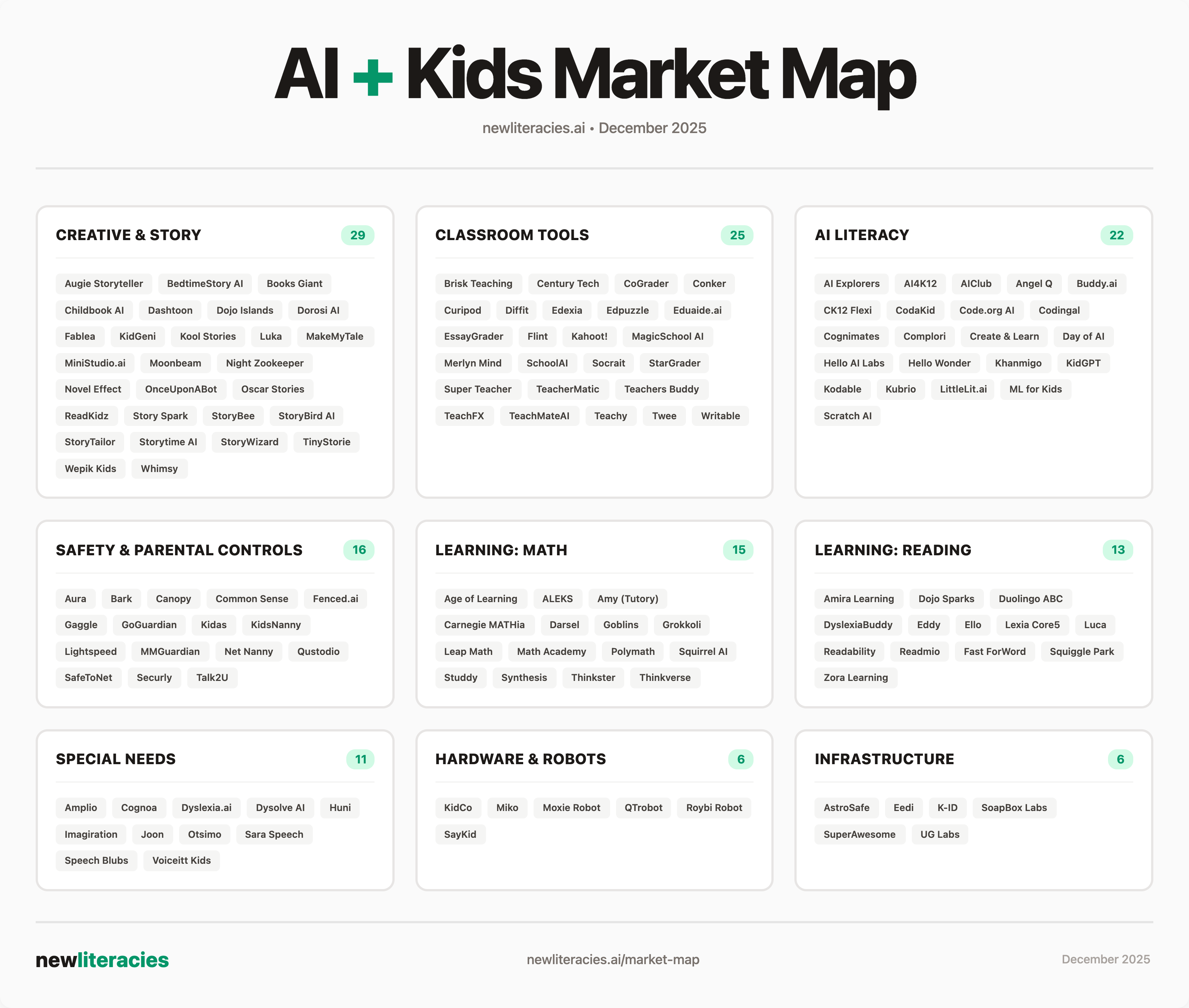
I started tracking companies in a spreadsheet. A year later, it’s 140+ entries.
Some are exciting. Most will fail (no judgment—it’s just extremely hard building in this space). A few are solving problems that matter.
Here’s what I’ve found.
What I Actually Recommend
I’m not going to cover all 140+ products. Here are the ones I’ve tested with my kids that are worth knowing about.
Reading
Ello is the best AI reading coach I’ve seen for young kids. It listens to your child read aloud, coaches fluency in real-time, and actually keeps them engaged.
Dojo Sparks (disclosure: I’ve worked on this) takes a different approach—focusing on phonics and letter sounds for ages 3-9. Sparky listens as kids sound out letters and adapts to their level. We’ve tested it with thousands of families, kids LOVE talking to Sparky. My 2yo is just getting into it. I’m biased, but think it’s clearly the best way to learn to read.
Eddy also shows promise—currently focused on language learning through 1:1 AI tutoring sessions. Real-time voice conversations that adapt to kids’ interests and level.
Math
Synthesis doesn’t look like traditional math tutoring. Kids solve complex problems through collaborative games. The product adapts the difficulty and interacts with kids to keep them engaged. My eldest went through a phase of loving it (but has since cooled off).
Goblins is an AI math tutor that lets kids speak and draw their thinking naturally. It uses Socratic questioning instead of just giving answers. Built mostly for teachers for K-12, it’s one of the better product I’ve seen in this space.
Math Academy is focused on older kids and serious about learning science—spaced repetition, knowledge graphs, adaptive pacing. They don’t seem to have nailed fun or engagement, but I’m not sure that’s what they’re going for. Worth knowing about if you have a motivated learner.
Safety & Screen Time
This is controversial territory. I’m personally delaying smartphones for my kids after reading Jonathan Haidt’s work. But I know many parents make different choices based on their circumstances.
Bark uses AI to monitor 30+ apps and flag concerning content—bullying, predators, explicit material. The approach is interesting: rather than blocking everything, it alerts parents to actual risks. Not perfect, but one of the more thoughtful products in a space that’s easy to get wrong.
The tracking/monitoring space makes a lot of people uncomfortable. I get it. But for parents who’ve decided their kids need devices, having AI-powered safety tools seems better than nothing.
For Developers
If you’re building in this space, here are three companies top of mind:
Eedi is building APIs for learning products, currently focused on math. Solid research with DeepMind about efficacy of AI-backed tutors.
CZI (Chan Zuckerberg Initiative) is putting serious resources to work, with APIs for edtechs and big companies. Their Learning Commons provides infrastructure for the field.
K-ID — I predict increasing regulation around AI for kids, and K-ID is well positioned as a compliance layer for youth apps.
Storytelling
This category is a bloodbath of competition—29 products in my market map, all fighting for the same slice of attention. Most use AI to co-create stories with kids. It just seems too easy to build one of these.
I haven’t found one I’d use with my kids. The space is too crowded, the products too similar, not all that engaging.
What I’m Looking For
Two categories feel underserved to me right now.
Hardware
My favorite kids product of the past year isn’t AI-powered—it’s the Yoto Player. Physical audio player, no screens, kids control what they listen to. Simple, focused, real.
That got me thinking: where’s the AI-powered version? What would a Yoto with conversational AI look like? A device kids could actually talk to, that responds intelligently, without needing a screen or feeling like a smart speaker.
The hardware category is small—only a handful of AI-powered physical products for kids exist. Most are robots. Most are expensive. Many are a bit creepy. Suspect they end up in the closet after a month.
But the interaction model matters. Kids relate differently to physical objects than apps. As a parent, I want fewer screens. As a product builder, I see hardware as a genuine differentiation opportunity. Hardware is famously hard, but I think there’s space here.
Curiosity Tools
I built Curio earlier this year—a custom GPT designed to spark curiosity in my kids. I wrote about it a few months ago. It worked better than I expected for specific use cases, but never became a habit.
The category is sparse. A few products exist, but nothing has nailed the interaction model for helping kids explore questions in a way that feels genuinely fun. ChatGPT is too transactional. Voice-only interfaces break in noisy kitchens. Traditional chatbots don’t work for kids.
One I’m following: DIY.org has been around for years—they’ve built a community for kids to share creative projects. They changed hands last year and are now shipping some interesting AI-powered features for kids. Worth watching to see how they evolve the platform.
What would a curiosity companion actually look like? What’s the right balance of structure and open-endedness? How do you make exploration feel like play?
We’re exploring fun stuff here at ClassDojo, and I’m watching the space closely.
The Full Map
I’ve built a searchable market map of all 140+ products at newliteracies.ai/market-map.
You can filter by age range, category, geography, whether I’ve personally used it. Each product includes descriptions, target audience, pricing model. It’s not comprehensive—this space moves too fast. But it’s the most complete resource I’ve seen for anyone building in AI for kids.
Bookmark it. Share it with your team. Let me know what’s missing!
What Am I Missing?
I know there are products I haven’t found yet. Companies building in stealth. Tools being tested in schools I haven’t heard about. Products launching in the next few months.
What should I be tracking? What’s working for your kids? What am I wrong about?
Comment below or ping the form on the site. I’ll keep updating the map as I learn more.